What is a buckwheat pillow, and is one right for you?
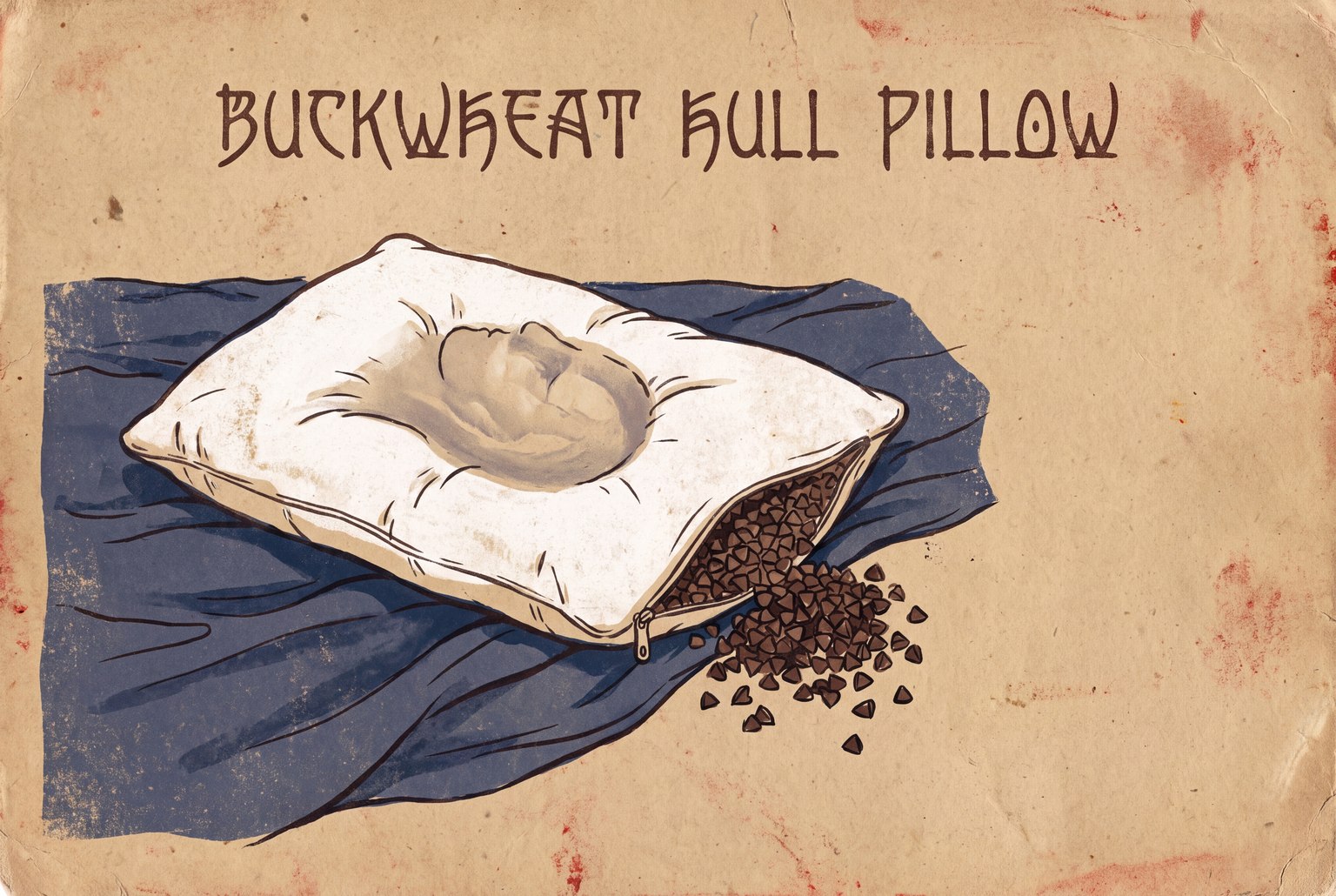
A buckwheat pillow gives up softness in exchange for shape. You press the hulls into the height you want, and they stay put until morning. That suits some people very well. Others give up within a week, and the reasons are nearly always the same three: weight, noise and allergy history.
Short answer: A buckwheat pillow is a zippered cotton case full of buckwheat hulls, and you fill it to your own height. A standard 20 by 26 inch pillow weighs anywhere from about 4 pounds (Natural Linens) to 12 to 13 pounds (PineTales), depending on how full the seller packs it. It suits people who want firm support they can adjust. Skip it if you are allergic to buckwheat or need silence to sleep.
This guide is for: people shopping for their first buckwheat pillow, and people wondering whether the one they own is filled right.
Key Takeaways
- A standard 20 by 26 inch buckwheat pillow weighs anywhere from about 4 pounds to 12 to 13 pounds, depending on the seller (Natural Linens; PineTales). The fill weight tells you more than the size does.
- In a Korean study, new buckwheat pillows carried about 12 times the endotoxin of new synthetic pillows: 60,950 against 4,887 EU/g (Journal of Korean Medical Science, 2004).
- We read 10 seller pages on September 25, 2026. 4 stated a weight for the size on sale, 1 gave only a hedge, and 5 gave no weight in the text we read.
On This Page
What is a buckwheat pillow, and what is inside it?
A buckwheat pillow is a cotton case filled with the outer shells of buckwheat seeds, which lock together and hold the shape you press into them.
The filling is the hull, the shell that milling strips off each buckwheat seed. Some shoppers call it a "husk"; this guide says hull from here on. Each hull is stiff and curved. When you pour them together they interlock instead of flowing like sand, which is why the pillow keeps the dent your head makes rather than springing back.
The traditional Japanese version is called sobakawa, and it is small. Hullo notes that its 14 by 20 inch size is closer to traditional Japanese pillows (Hullo FAQ). American sellers went bigger. Hullo, for example, sells a small at 14 by 20, a standard at 20 by 26 and a king at 20 by 36 inches (Hullo sizing guide).
The case has a zipper so you can add or remove hulls. That zipper is the whole design. You set the height, then shape the pillow with your hands each night. The hulls barely compress, so the pillow feels firm at almost any fill level. Sleep Foundation credits these pillows with adjustable height, strong support and durability. It also says many people find them too firm (Sleep Foundation, 2026). For more on the hull itself, see our page on what a buckwheat hull is, and why its shape matters.
How heavy is a buckwheat pillow in a standard 20 by 26 size?
Seller pages put a standard 20 by 26 inch buckwheat pillow anywhere from 4 pounds to 13 pounds, so the fill level matters more than the size.
Heavier than most people expect. Hullo describes its standard pillow as weighing around 10 pounds (Hullo). Bean Products fills its standard size with about 4 pounds of hulls, which leaves it roughly two-thirds full (Natural Linens). PineTales lists its 20 by 26 inch pillow at about 12 to 13 pounds and 6 to 7 inches thick when full (PineTales). Same case, three times the fill. For the sleeper, that spread decides whether the pillow arrives low and pliable or tall and firm.
Weight is a stand-in for how full the case is. Hullo's rule of thumb is that each pound of hulls takes up about 200 cubic inches (Hullo FAQ). On that rule, a 12 pound pillow holds about three times the hulls of a 4 pound one. You feel that as height and firmness. Part of the spread is natural. Beans72 says it fills by volume, so weights vary with seasonal crop conditions (Beans72 on Amazon).
The weight also affects how you handle the pillow at night. One customer review posted on Hullo's site calls the standard size extremely heavy. The reviewer adds that it is unwieldy for anyone who sleeps with an arm under the pillow (Hullo).
| Seller page | Size | Weight the page states |
|---|---|---|
| Natural Linens (Bean Products) | Standard | about 4 lb, two-thirds full |
| Hullo | Standard | around 10 lb |
| PineTales | 20 x 26 in | about 12 to 13 lb |
| Sobakawa on Amazon | 19 x 29 in | 7.5 lb |
How high should a buckwheat pillow be for the way you sleep?
Side sleeping needs the most height and stomach sleeping the least; a buckwheat pillow lets you set that height by adding or removing hulls.
Height is the pillow's real job. For side sleeping, it has to fill the space between your ear and the mattress, and the width of your shoulders sets that space. When you lie on your back, it only needs to support the curve of your neck. Stomach sleepers need it low or left out.
The neck notices small changes. In one study, 10 healthy adults lay on pillows 110, 130, 150 and 170 mm high, which is roughly four to seven inches (PeerJ, 2016). Average pressure under the head was about 30% higher on the tallest pillow than on the lowest. Moving from the lowest to the tallest raised the cervical angle by 66.4%. Changing the pillow by about 2 inches changed the shape of the neck.
With a buckwheat pillow you can make those changes a handful of hulls at a time. Small pillows have a limit, though. Hullo says its 14 by 20 inch pillow cannot go much past 4 inches high before it becomes too firm (Hullo sizing guide). Start full, then take hulls out. Our guide to what pillow height a buckwheat pillow needs, by sleep position goes further.
| How you sleep | Where to start | Sign the height is wrong |
|---|---|---|
| Side | Full enough to keep your head level with your spine | Chin tips toward the top shoulder |
| Back | A low center with a firmer ridge under the neck | Chin pushed toward the chest |
| Stomach | Nearly empty, or a thin section at one edge | Neck bent backward by morning |
Does a buckwheat pillow sleep cooler than foam or down?
Hulls leave air gaps that foam does not, so the pillow feels cooler, but we found no published study that measured its temperature in use.
Probably, but the evidence is mostly about structure. Loose hulls leave gaps that a block of foam does not, and air can move through them. Sleep Foundation says the hulls keep air moving through the pillow and do not trap body heat the way foam does (Sleep Foundation, 2026). Hullo goes further and says feather and foam pillows hold heat and moisture. That is a seller describing its competitors (Hullo).
We found no peer-reviewed study that measured the temperature of a buckwheat pillow in use. Review sites run their own checks. Sleep Doctor's review page describes using thermal sensors to judge heat retention, along with notes from its testers (Sleep Doctor). Those checks are useful. They are not published trials with methods you can inspect.
Two things make the cool feel believable. First, the hulls do not wrap around your head, so less of your skin touches the pillow. Second, you can turn the pillow to a side that has been open to the room air. Treat "cooling" as a reasonable inference rather than a tested number.
The cover matters too. Tightly woven cotton ticking lets air through. A thick synthetic cover over the hulls may cancel some of that airflow, so check the fabric before you buy.
Can a buckwheat pillow cause allergies or asthma?
Hulls rarely cause trouble, but flour dust left on them has triggered asthma in case reports, and new pillows can carry high endotoxin levels.
Yes, though it is rare, and the hull itself is usually not the cause. An allergist told HealthDay the hull itself is unlikely to cause problems. Processing, though, can leave flour residue in the pillow (HealthDay, 2001). Buckwheat flour is a strong allergen.
The case reports are consistent. Korean doctors described three children whose night-time asthma improved during seven days without their buckwheat pillows (HealthDay, 2001). A 2003 case report described a patient who developed asthma and worsening allergic rhinitis after using a buckwheat pillow, and whose symptoms cleared once he stopped (Thermo Fisher allergen encyclopedia). A 2009 US case report linked earlier use of a buckwheat pillow to anaphylaxis the first time buckwheat food was eaten (Korean Journal of Pediatrics, 2016).
New pillows also carry more endotoxin, a bacterial product that can make asthma worse. In a Korean study, new buckwheat pillows averaged 60,950 EU/g of endotoxin, against 4,887 EU/g for new synthetic pillows. After three months, dust mite allergen levels were about the same on both types (Journal of Korean Medical Science, 2004).
Buckwheat allergy can also come with others. Doctors have reported cross-reactivity between buckwheat and latex, rice, poppy seeds and quinoa (Korean Journal of Pediatrics, 2016). If you have asthma or react to any of these, ask your allergist before you buy.
What do seller pages tell you about fill weight?
Fewer than half of the seller pages we read state what the pillow you are buying weighs, the figure that tells you how full it is.
We read 10 seller product pages for buckwheat pillows on September 25, 2026, and counted one thing: whether each page says what the pillow on sale weighs. We only read what the pages say. This count covers page text alone, and no pillow was weighed for it.
| What the page states | Pages | Which pages |
|---|---|---|
| A weight for the size on sale | 4 | PineTales Platinum, PineTales Signature, Beans72 king, Sobakawa queen |
| Only a hedge such as "varies" | 1 | PineTales Hybrid |
| No weight in the description we read | 5 | Hullo standard, Bean Products standard, Beans72 standard, Zen Chi king, Zen Chi 20 x 26 |
Pay the most attention to the middle row. The PineTales hybrid page says only that weight varies with fill type and adjustment level. That tells you the pillow can be adjusted, but not what arrives at your door or how full it will be.
Our reading: a page that hides the weight hides the fill level, and the fill level decides the height, the firmness and how the pillow handles. Marketplace listings sometimes put a shipping weight in a separate details table. Check there as well. If you find no figure in either place, ask the seller before you order.
Who should buy a buckwheat pillow, and who should skip it?
A buckwheat pillow suits people who want firm, adjustable support; it is a poor fit for light sleepers and anyone allergic to buckwheat.
Buy one if you want support that stays where you put it. The usual fans are people who wake up with a flattened pillow and people who sleep hot. Skip one if you need quiet, want softness, or react to buckwheat.
Noise is the most common reason people give up. Hullo's own listing says the pillow makes a gentle rustling noise when moved (Hullo on Amazon). Some people stop hearing it within days, and others never do.
Price is the other hurdle. Hullo's sizing guide lists a starting price of $59 (Hullo sizing guide), well above a basic polyester pillow. That money buys a pillow you can refill instead of replacing, which narrows the gap over several years.
| Good fit | Poor fit |
|---|---|
| People who want firm support that holds all night | People who want a soft pillow to sink into |
| People who run hot and dislike foam | Light sleepers bothered by rustling |
| People who like to fine-tune height | Anyone with asthma or a buckwheat allergy |
| People who sleep on their back or side | People who move their pillow a lot at night |
Children need extra thought. The AAP says to keep pillows and other soft items out of a baby's sleep space (AAP). With an older child, keep in mind that the Korean asthma cases above all involved children.
How do you care for buckwheat hulls and when do you replace them?
Keep the hulls dry, wash only the case, and top up or replace the fill once the hulls flatten and stop holding the shape you give them.
Keep the hulls dry and leave them alone. Hullo's instructions are to empty the hulls into a dry container and wash only the case in cool water. Let the case air dry, and pour the hulls back only once it is completely dry (Hullo on Amazon). The hulls never need washing.
Moisture is the main thing to watch. Hulls are plant material, and a damp pillow is a bad place for them. Our guide to whether a buckwheat pillow can get moldy or bring bugs into your bed covers that risk in detail. Air the pillow out now and then, and never seal it in a plastic bag while it is damp.
Hulls wear out slowly. Hullo says a pillow can last many years with proper care. Over time, though, the hulls gradually flatten and lose their spring, which reduces airflow and height (Hullo FAQ). You will notice it when the pillow needs more hulls to reach its old height. Topping up costs less than replacing. PineTales says 10 pounds of hulls is enough to refill a standard 20 by 26 inch pillow, and 5 pounds refills a 14 by 20 (PineTales refill page).
There is a simple test. Press your hand into the pillow and lift it away. If the dent slumps flat instead of keeping its edges, the hulls are worn out.
Common questions
Is a buckwheat pillow good for neck pain?
It can help if your problem is pillow height. We found no trial that compared buckwheat filling on its own against other fillings. The research does show that pillow height changes the angle of the neck, and buckwheat makes height easy to adjust.
Are buckwheat pillows noisy?
Yes, they rustle when you move. Some sellers advertise pre-polished hulls as quieter, while PineTales uses a padded two-layer cover to soften the sound (PineTales). If you need silence, try one before you commit.
How long does a buckwheat pillow last?
Several years, and longer in a room where moisture never reaches the hulls. The case usually outlasts the hulls. Hullo notes that the hulls gradually flatten over time (Hullo FAQ), so plan to top up the fill rather than buy a new pillow.
Can you wash buckwheat hulls?
No. Wash the case and keep the hulls dry. Hullo says the hull filling does not need cleaning at all (Hullo on Amazon). Airing the pillow is enough.
What makes a Japanese buckwheat pillow different?
Mostly its size. A traditional sobakawa is small, close to 14 by 20 inches. PineTales lists its 14 by 20 at about 6.5 pounds, against 12 to 13 pounds for its 20 by 26 (PineTales).
Is a buckwheat pillow safe for children?
Not for babies: keep all pillows out of an infant's sleep space (AAP). With older children, watch for coughing or wheezing at night. The Korean pillow asthma cases involved three children (HealthDay, 2001).