What is a buckwheat hull, and why does its shape matter?
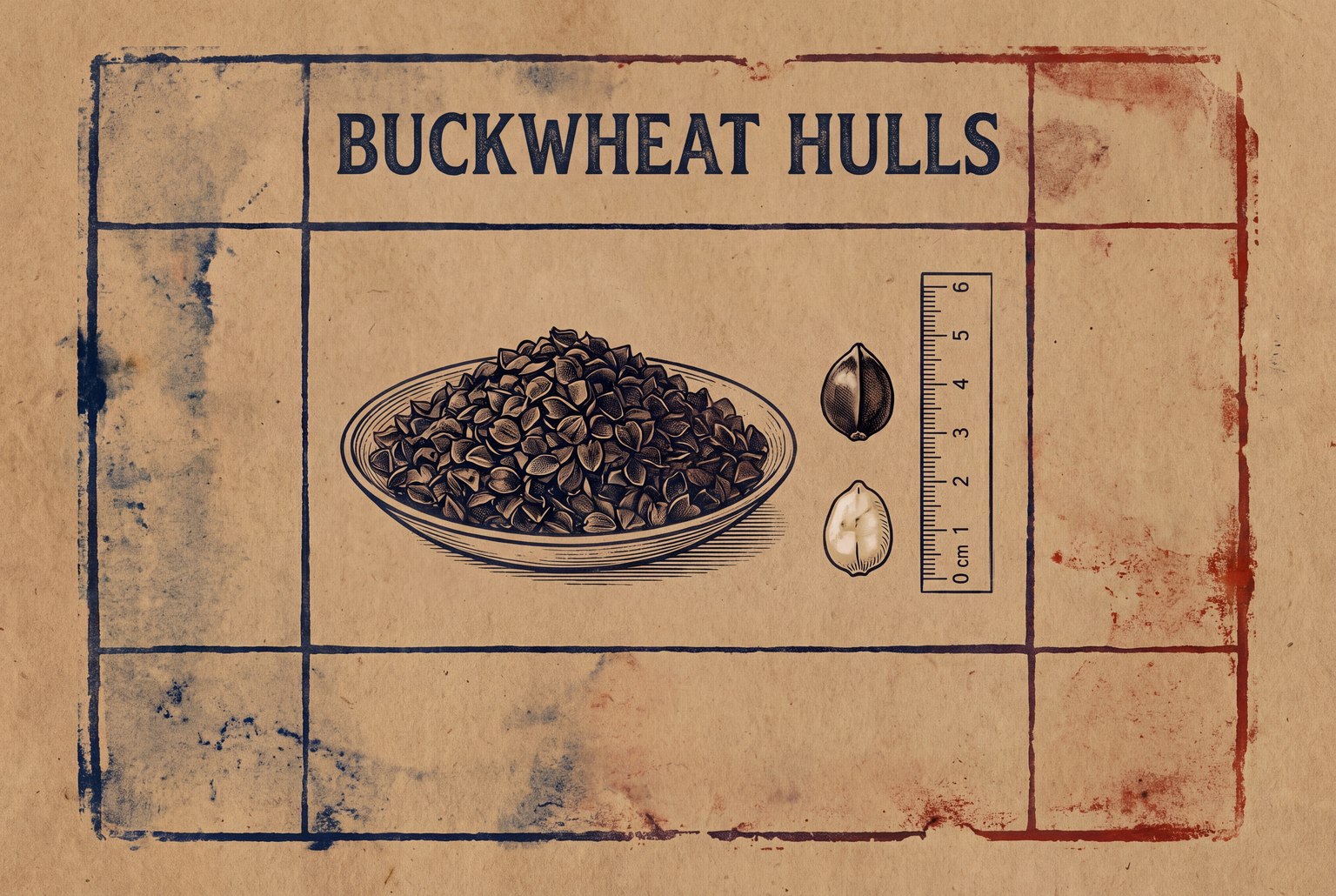
A buckwheat pillow is mostly air, held open by a few thousand small hard shells. The shape does most of the work. Learn what those shells are and what shape they hold, and you can predict almost everything the pillow will do under your head.
Short answer: A buckwheat hull is the hard outer fruit coat of a buckwheat seed. Mills strip it off first, and the grain inside goes on to become groats or flour. The shell is dark, dry and three-sided. It is mostly lignin and cellulose. Filled into a case, hulls behave like gravel that stops moving: the pile takes the shape of your head and holds it until you move again.
This guide is for: anyone deciding whether this filling suits them, and anyone trying to work out what the listing in front of them is describing. For the pillow itself rather than the filling, start with our introduction to buckwheat pillows.
Key Takeaways
Three numbers to carry away: what share of the grain the shell is, what a pound of it fills, and how many pages we read for this guide.
- The shell is a fifth to a third of the grain. Wet-milling recovered a hull fraction of 20.1% (Journal of Cereal Science, 2014), while a dehulling paper puts the shell at about 30% of grain weight (IJCMAS, 2018).
- One pound of hulls fills roughly 200 cubic inches, a figure a seller publishes for estimating fill (Hullo fill calculator). A 10 lb standard pillow therefore holds about 2,000 cubic inches, near 33 litres.
- We read 12 selling pages on 20 September 2026. Six used one word for the shell, five used two words on the same page, and one led with the other word.
On This Page
Nine plain questions, in the order a first-time buyer tends to ask them. Jump to the one you came for, or read straight down.
What is a buckwheat hull, and where does it come from?
A hull is the hard outer shell of a buckwheat seed, removed at the mill before the grain inside becomes flour or groats for the table.
The fruit of the buckwheat plant is an achene, meaning a dry single-seeded fruit. Botanists identify its outer covering as the pericarp. Millers call it the hull, and it is the first layer taken off, leaving the dehulled groat behind (Purdue New Crops). The fruit is triangular in outline and measures over 5 mm long (Fagopyrum review, 2020).
Two published figures demonstrate how little nutritional value the shell carries. Protein sits at 4% in the pericarp against 16.4% in the dehulled groat (Purdue New Crops). The shell is structure, not nourishment. Lignin and cellulose are the dominant components of the seed hull (Int. J. Mol. Sci., 2019). Lignin and cellulose also stiffen wood.
The pillow filling is therefore a milling by-product, and a considerable one. Somewhere between a fifth and a third of every harvested grain arrives as shell. You are sleeping on the portion of the crop that food buyers do not want.
| Part of the grain | What it is | Protein |
|---|---|---|
| Hull (pericarp) | Hard fibrous outer coat, dark brown to black | 4% |
| Whole grain, hull on | Shell plus groat together | 13.8% |
| Dehulled groat | The part sold as food | 16.4% |
| Endosperm | Starch store inside the groat | 10.1% |
| Embryo | Germ | 55.9% |
Protein figures: Pomeranz and Robbins 1972, reported by Purdue New Crops.
Why do listings use two different words for the same shell?
The material is identical whichever name a listing prints. This guide uses a single word and identifies the alternative you will see.
Both names identify a single layer of the fruit. A feed-science reference treats the two words as equivalent in one line, describing the material as the seed pericarps remaining after dehulling (Feedipedia). Shoppers frequently type husk. We use hull from here onward, because that is the terminology the milling literature uses.
We read 12 pages selling buckwheat pillows or loose fill on 20 September 2026, and counted which word every page applied to the shell. This was a count of vocabulary on screen. We weighed nothing and tested nothing, and no sample passed through our hands.
| What the page did | Pages | Note |
|---|---|---|
| Used the house word only | 6 | Product pages and buying guides from four sellers |
| Used both words on one page | 5 | Usually one word in the title, the other in the body copy |
| Led with the reader's word in the page title | 1 | A European linen seller writing for a shopper who types it |
The practical lesson is brief. A listing's word choice tells you nothing about the material and a considerable amount about whoever composed the copy. Read the fill weight and the cover fabric instead.
What shape is a hull, and why does that shape hold a load?
Each hull is a three-sided shell with flat faces and sharp edges, so a pile of them interlocks instead of flowing apart.
The achene is triquetrous, meaning three-angled (Fagopyrum review, 2020). Split that shell and you obtain curved plates with straight edges. Pour several thousand into a case and they wedge against one another. Push slowly and the pile flows. Stop pushing and it jams. Your head supplies the push, and the pile locks around its shape.
Here is a figure no seller publishes, calculated from two published ones. At 200 cubic inches per pound (Hullo fill calculator), loose whole hulls sit near 138 kg per cubic metre. Grind those identical hulls through a 1.27 mm screen and the fragments settle at 392 kg per cubic metre (US Patent 8,133,357). Destroy the shape and the material becomes 2.8 times denser.
That ratio is the entire argument for this filling. Roughly two-thirds of what you purchased is air, and the shells hold that air open in channels rather than pores. Heat escapes through those channels. So does the sound of a hull sliding past its neighbour, which is why the rustle question arises so often.
How much does the fill weigh, and how much do you need?
Sellers state fill weights from about 1 lb to 15 lb, and the number you need depends on the case size, not on the name on the label.
Published weights cluster tightly. One seller lists 10 lb for a 19 by 25 inch standard or queen and 15 lb for a 20 by 36 inch king, plus 3.5 lb and 2.5 lb in smaller sizes (Soaring Heart). Another seller states that 3 to 4 lb replaces the entire contents of its bed pillow (Bucky). A third reports that a 10 lb bag fills a standard pillow with a quantity remaining (Hullo FAQ).
The table below converts those weights at 200 cubic inches per pound, then divides by the case area. The final column is the thickness the pillow would carry if you flattened it evenly, a figure no manufacturer publishes.
| Size as listed | Stated fill | Hull volume | Flattened thickness |
|---|---|---|---|
| Standard/queen, 19 x 25 in | 10 lb | 2,000 in³ | 4.2 in |
| King, 20 x 36 in | 15 lb | 3,000 in³ | 4.2 in |
| Medium, 14 x 20 in | 3.5 lb | 700 in³ | 2.5 in |
| Small, 12 x 16 in | 2.5 lb | 500 in³ | 2.6 in |
| Mini, 7 x 12 in | 1 lb | 200 in³ | 2.4 in |
Most people prefer an average thickness between 3 and 4 inches, according to the calculator's own guidance (Hullo fill calculator). Full-size pillows arrive above that band. Expect to remove hulls, and retain them.
What height should a hull pillow hold under your head?
Published pillow work tests heights between 80 mm and 170 mm, and the right one for you follows your shoulder, not a chart.
Height is the single variable a hull pillow permits you to set yourself. Ten supine participants lay on pillows of 110, 130, 150 and 170 mm in a Hong Kong study. Average cranial pressure at 170 mm registered about 30% higher than at 110 mm, while average cervical pressure at 110 mm was 65% lower than at 170 mm (PeerJ, 2016). Height transfers load between skull and neck.
Side sleeping requires more. Nine participants lay on foam-latex pillows at 8, 10, 12 and 14 cm, with and without neck support, and a sub-low individualised height combined with neck support scored best for comfort (Med Biol Eng Comput, 2024).
Do not extract a single number from that. A review of the field concluded that no firm conclusion on optimal height exists for either supine or side sleeping (Healthcare, 2021). Your shoulder width and neck length determine it. Our height guide describes the wall test for identifying yours.
Does the research support buckwheat as a pillow filling?
One Polish team put buckwheat fill through people trials and lab tests. The findings are useful. The sample sizes stay small.
The best single study we located is not about pillows at all. A Wrocław group filled cotton mattresses with buckwheat hulls and followed 60 people in three groups: participants with skeletal problems, participants at risk of pressure ulcers, and healthy volunteers. Alongside that, they ran examinations for colonisation by fungi, bacteria and arthropod pests, plus rheological, chemical and flammability tests. Their summary is that all tests indicate high usefulness of the material (Int. J. Environ. Res. Public Health, 2021).
Read that carefully before you rely upon it. It is one team, one filling source, 60 participants, and mattresses rather than pillows. The comfort findings are self-reported. The microbial and pest work transfers best to a pillow, because it addresses what survives in a dry granular filling.
What the literature does not offer is a controlled trial of hull pillows against foam for neck pain. That comparison remains unpublished at any useful size. Anyone telling you the material is proven for pain relief is ahead of the available evidence. Discount that claim accordingly.
Who should avoid buckwheat hulls altogether?
A small number of people react to buckwheat itself. Case reports tie pillow use to asthma, rhinitis and later food reactions.
Buckwheat is a genuine allergen. The pillow is a recognised route of exposure. The first United States case of pillow-induced asthma and worsening allergic rhinitis was reported in 2003, in a patient with a 4+ skin prick response whose symptoms improved once the pillow was removed (Ann Allergy Asthma Immunol, 2003). A later report describes a 36-year-old man with two years of asthma, contact urticaria and conjunctivitis from sleeping on one, who subsequently experienced anaphylaxis after eating buckwheat (PubMed, 2006).
A case series of two previously healthy women with no prior buckwheat in the diet describes sensitisation apparently occurring through pillow use, with IgE to the 23 kD allergen Fag e 1 (J Allergy Clin Immunol, 200903135-7/fulltext)). Inhalation is the secondary exposure route after eating (Thermo Fisher allergen encyclopedia).
These are case reports, not incidence rates. They cannot tell you your odds. They do establish the rule: if you react to buckwheat as food, this filling is not for you, and a clinician should decide that, not a pillow page.
How do hulls behave with heat and moisture?
Air moves between hulls rather than through them, which is why the fill feels cool and why damp air is the thing to keep out.
A hull is a shell, not a sponge. The gaps between shells carry the airflow. Body heat escapes along those gaps instead of remaining inside a solid slab. That is the honest version of the cooling claim, and it holds whatever the label announces.
Moisture is the genuine hazard. The shell is constructed from lignin and cellulose (Int. J. Mol. Sci., 2019), so it absorbs moisture from the air like any plant fibre. Damp hulls clump, develop an odour, and stop sliding past each other. Never soak the filling. Tip it into a dry bowl, wash the cover separately, and leave the hulls in moving air for several hours before they return.
Cleanliness before the pillow reaches you matters as well. One seller states its hulls are triple-cleaned and 99.9% dust free, which is a seller's claim rather than a tested figure (Bucky). Dust from the milling, not the shell itself, is what irritated the children in the older asthma literature. Our cleaning guide covers the routine in full.
How long do hulls last, and what wears them out?
Hulls fracture slowly under nightly compression. Sellers price refills by the pound, which tells you how the material is meant to be kept.
A hull has no spring in it. Each one is a rigid plate that survives compression until an edge fractures. Fractured hulls pack together more tightly than whole ones. The density figures above demonstrate where that leads: broken pieces reached 392 kg per cubic metre against roughly 138 for whole loose hulls (US Patent 8,133,357).
You will feel the change before you observe it. The pillow sits lower at the identical fill weight, and it becomes quieter, because fewer sharp edges remain to slide. Weight stays constant while height falls. That is the signal to top up.
Refills are sold the way fuel is sold. One seller reckons 3 to 4 lb replaces the entire contents of its bed pillow (Bucky), and another sells 10 lb bags that fill a standard pillow with hulls remaining (Hullo FAQ). Store the bag you removed at setup in a sealed, dry container. It is your first refill, and it costs nothing.
Common questions
Six questions that arrive by email after the first week of use, answered with the same sources used in the sections above.
Are hulls and shells the same thing?
Yes. Hull, pericarp and fruit coat all name the outer layer of the achene, which millers remove first (Purdue New Crops). Shell is the everyday word for the identical object.
Can I wash buckwheat hulls?
Do not put them in water. The shell is plant fibre and retains dampness. Empty the filling into a dry bowl, wash the cover separately, and return dry hulls to a dry cover.
Do hulls attract dust mites?
The Wrocław team examined buckwheat filling for colonisation by fungi, bacteria and arthropod pests and reported high usefulness across all tests (Int. J. Environ. Res. Public Health, 2021). That is one study on mattresses, so treat it as encouraging rather than settled.
Why is the pillow so heavy?
Fill weight explains it. A standard size carries about 10 lb and a king about 15 lb on one seller's published list (Soaring Heart). Remove hulls and the weight decreases along with the height.
Will it be noisy?
Some sliding sound is inherent in the material. The shells move against each other whenever you turn over. Most people stop registering it within a week or two, and a thicker cotton cover muffles it.
Are hulls compostable?
The shell is lignin and cellulose (Int. J. Mol. Sci., 2019), so spent filling decomposes in a garden heap. Spread it thinly. A deep layer sheds water.