Should you buy polished or unpolished buckwheat hulls, and what does the processing step change?
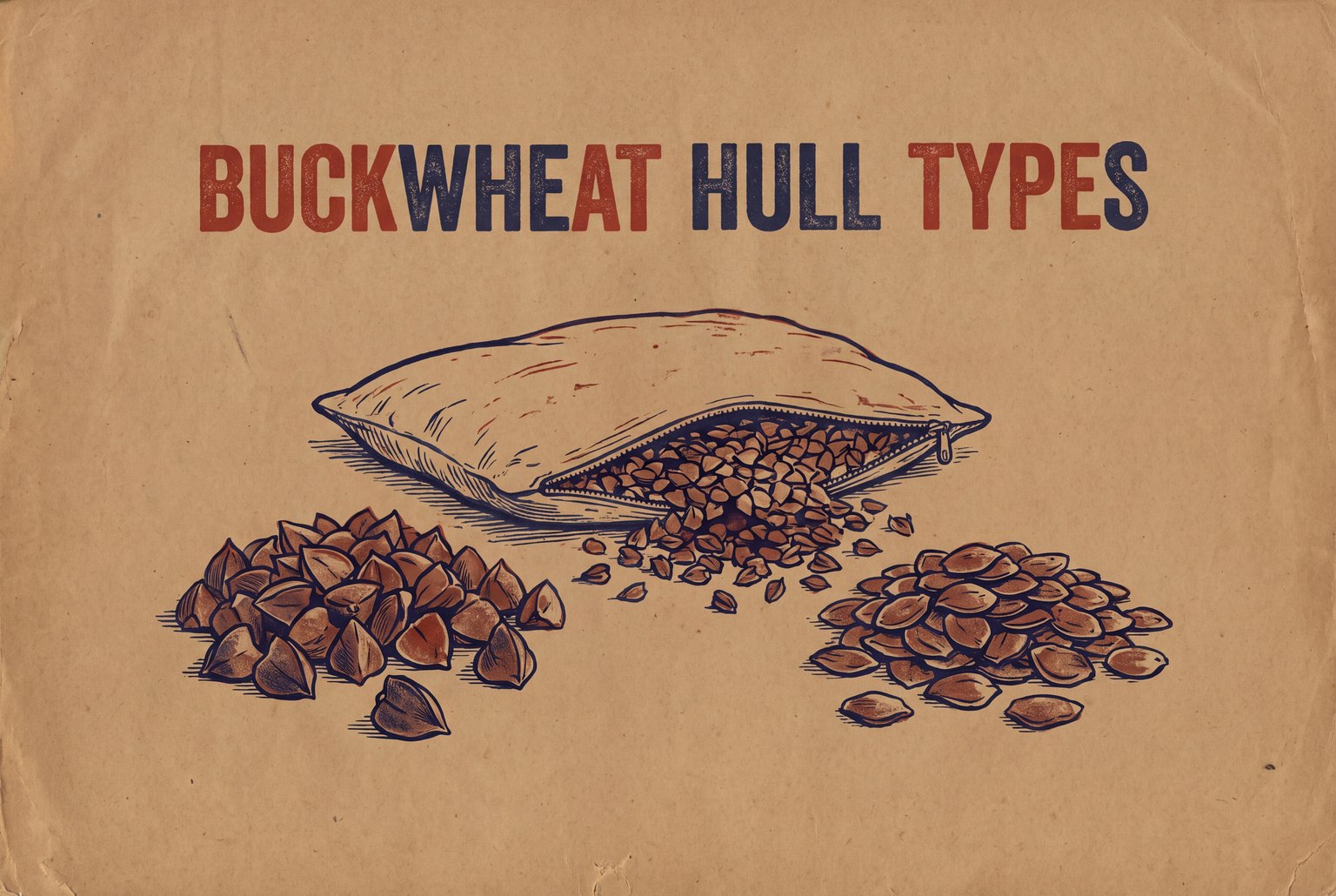
Two bags of hulls can look almost identical. They behave differently the moment your head lands. One rustles and locks. The other slides and whispers. The difference is usually a processing step that happens long before the material reaches the cover on your bed. Almost nobody explains it at the point of purchase.
Short answer: Polishing grinds the sharp corners off a three-sided hull. You get a quieter, smoother pillow in exchange for some grip. One manufacturer puts the noise reduction at up to 68%. That figure is its own, generated by its own testing, not an independent result. We read 16 seller pages on 22 September 2026, and only 2 took a public position against polishing. Unpolished hulls stay loud, stay coarse, and hold a shaped hollow longer.
This guide is for: anyone deciding between a rough-hull pillow and a smoothed one, and anyone whose partner has started commenting on the noise.
Key Takeaways
Three numbers to carry into a purchase: one seller claim we could not verify, 16 pages we read, and zero organic rules on polish.
- The only quantified noise claim in this category is up to 68%, and it belongs to one manufacturer that tested its own hulls. No decibel figure, sample size, or method was published anywhere we could read. Treat it as a direction of travel rather than a measured result.
- Of 16 hull pages we read on 22 September 2026, 2 said the hulls were never polished and 12 never used the word at all. Silence is the norm. If a page does not mention shaping, you cannot infer which material you are purchasing from the listing text.
- USDA organic rules run to one part of the regulations, 7 CFR part 205, and none of it addresses hull shaping. An organic buckwheat pillow can hold polished or rough hulls. Certification covers farming and handling records rather than finish.
On This Page
Eight questions, in the order a buyer hits them: what polishing does, what it costs, and what the label can never tell you.
What does polishing do to a buckwheat hull?
Polishing breaks the pyramid corners into flatter faces, so the fill slides more, grips less, and sounds softer under a moving head.
A hull is the shell that came off the seed. Some listings call it a "husk"; this guide says hull throughout. Its natural form has three sides and hard corners. Those corners are the whole mechanism, as we set out in what a buckwheat hull is and why its shape matters. Polishing is abrasion. Hulls are tumbled together or driven through moving air until the corners gradually wear into flatter faces.
The manufacturer that markets this treatment describes it as a proprietary process that converts sharp corners into flat sides. That is a description of its own production line, rather than an industry standard other manufacturers follow.
Two consequences follow directly from the geometry. Flatter pieces pack tighter, and flatter pieces slip past each other more easily. One hull supplier states on its own page that hulls are empty shells rather than edible material, and the same supplier's bulk listing describes flattened hulls as denser than intact ones with weaker grip on each other (Hullo). Abrasion is a matter of degree rather than a single setting. At the far extreme of that axis sits milling, where hulls are reduced to powder and surrender their structure entirely. Nothing sold as pillow fill travels that far. The comparison still tells you the direction every polishing pass moves in: towards smaller, smoother, denser particles that behave progressively less like a stack of tiny shells.
Do polished hulls sleep quieter than unpolished ones?
The 68% figure comes from one seller's own testing of its own hulls. Nobody has published a decibel reading, a method, or a sample size.
Probably, yes, and that is as far as an honest answer can carry you. Softer edges make a softer sound, which is unsurprising. What nobody has published is how much, under what loading, at what frequency.
One quantified claim circulates in this market. It says polishing reduces movement noise by up to 68% compared with unpolished hulls. That number belongs to the manufacturer. It was generated in-house, attached to its own product. We looked for a decibel reading, a description of the test rig, or an outside laboratory behind it. We found none. This publication does not link to marketing pages as sources of evidence.
Useful context comes from noise research rather than pillow manufacturers. The WHO guidance for community noise recommends under 30 dB(A) in bedrooms at night for good quality sleep, and gives under 40 dB(A) as an annual average outside bedrooms (WHO Europe). Those are room and façade levels, not pillow levels. A sound source 5 cm from your ear is a different problem from traffic 20 m away. One point does carry over. A 2022 review updating the WHO evidence notes that arousals from noise do not appear to habituate fully, even among chronically exposed people (Environmental Health Perspectives, 2022). That is why certain people never settle, as covered in why buckwheat pillows are noisy.
How many sellers describe polishing, and what do their pages say?
We read 16 published pages about hull fill on one day and sorted every one of them by what it says about polishing, in three buckets.
We read 16 seller, retailer and manufacturer pages describing buckwheat hull fill, all on 22 September 2026. We counted what each one states about shaping. Nothing here was weighed or handled. This is a count of published wording, nothing else.
| Bucket | Pages | What the wording looks like |
|---|---|---|
| States the hulls are not polished | 2 | The fill is cleaned and treated, and the page says the natural shape is kept |
| Never mentions polishing at all | 12 | Screening, washing, heat, UV, roasted versus non-roasted, and silence on shaping |
| Markets polishing as a feature | 2 | Both from a single seller, describing a smoothing process and a noise reduction claim |
The middle bucket is the finding. Twelve of 16 pages leave the question unanswered, which means the default shopping experience gives you no reliable way to tell. A page can be remarkably detailed about cleaning. Finish still goes unmentioned. One refill listing states its hulls are triple screened, washed, then heat and UV treated. The same page says they are never polished (PineTales). Another supplier's bulk listing specifies a 35 lb box of non-roasted hulls. It warns that some hulls sold online are imported, roasted or fumigated (Open Your Eyes Bedding). Roasting and polishing are entirely different steps. Pages mentioning one rarely mention the other, so confirm both before you purchase.
Does polishing change how a buckwheat pillow supports your neck?
Grip is what holds a shaped hollow under your neck all night, and flatter hulls give up some of it for a smoother surface.
Support in a hull pillow is not springiness. You push the material aside and it locks into the new arrangement. The shape holds until you move again. Interlock is the support. Anything that rounds the contact edges trades a little of it away.
The manufacturer selling polished hulls states that support is unchanged by its process. A competing supplier states that flattened hulls grip each other less well (Hullo). Both are sellers. Neither has published a loading test. We treat the truth as sitting somewhere between them: a small loss of grip, large enough to notice if you want a tall shaped hollow, small enough to ignore if you do not.
Weight gives you a rough sense of how much material is in play. One manufacturer lists roughly 6.5 lb for a 14 × 20 inch pillow. The same page lists 12 to 13 lb for a 20 × 26 inch one (PineTales). Many shoppers search for "loft"; this guide says height. The height you need depends on your sleeping position, which we set out in pillow height by sleep position. Side sleepers with broader shoulders are the most exposed to a grip penalty. They ask the material to hold the tallest wall.
Does an organic buckwheat pillow have to use unpolished hulls?
USDA organic rules govern farming and handling records. They say nothing about whether a hull was polished, roasted, or left rough.
No. The two things are unrelated, and conflating them is the commonest shopping error in this category.
The USDA organic regulations sit at 7 CFR part 205. They were published on 21 December 2000 and took effect on 21 October 2002 (Federal Register, 2019). They set out how a crop is grown and how a handling operation documents itself. A certified operation must permit on-site inspection and retain records for not less than 5 years (eCFR, 7 CFR 205.400). Labelling tiers follow identical logic. An "organic" label requires at least 95% organic ingredients, and "made with organic ingredients" requires at least 70%. Operations selling under $5,000 annually are exempt from certification while still following the standards (eOrganic).
Read that list again, and you will see what is missing. Nothing in it describes hull shape, edge finish, or noise. A certified organic hull can be tumbled smooth. An uncertified hull can arrive with every corner intact. A cotton cover may carry its own textile certification. That certification covers the fabric, not the material inside it. Buy the certificate for exactly what it certifies.
Which processing steps matter more than polishing for dust?
Screening, washing and heat treatment decide how dusty a fill is. Polishing is a shaping step, and it is not a substitute.
The grit you feel is mostly two things: fine hull fragments, and flour residue remaining from milling the seed. Cleaning removes those. Shaping does not. One manufacturer publishes a four-stage sequence: triple screening, washing, heat treatment and UV. The same manufacturer states that many sellers skip the washing and UV stages entirely (PineTales).
The residue question carries a clinical literature, which is why it deserves more of your attention than finish does. A 2021 review searched PubMed from 1970 to 2020 and treats sleeping on buckwheat hull pillows as a household exposure route alongside diet and occupational handling. That review counted 41 published articles mentioning asthma and 9 mentioning buckwheat pillow allergy (Plants, 2021). The allergen is protein carried in the flour, rather than the shell material itself. Cleaning specification is therefore the relevant question for a sensitive sleeper, and finish is not.
| Step | What it targets | What you notice | Who states it |
|---|---|---|---|
| Screening | Oversized debris, broken pieces | Fewer fragments in the cover | Makers, on their own pages |
| Washing | Fine dust and flour residue | Less grit, less sneezing | 1 of the 16 pages we read |
| Heat treatment | Insects and eggs | No infestation on arrival | Several maker pages |
| UV | Surface microbes | Nothing you can feel | 1 of the 16 pages we read |
| Roasting | Not a cleaning step | Fragile hulls, faster breakdown | Named as a defect by 2 sellers |
| Polishing | Corners and edges | Softer sound, smoother feel | 2 pages, one seller |
How does polishing affect how long a hull load lasts?
Hulls crumble with years of load. Thinner walls after polishing may shorten that clock, and no seller publishes a break-down curve.
Every hull pillow dies the same way. The shells fracture under nightly compression and the material settles. The height drops. Then the shaped hollow stops holding. One retailer states that hulls compress after years of use and can be emptied and refilled to restore structure (Turmerry).
Abrasion removes material. A polished hull has less wall remaining than it originally started with. The plausible reading is a shorter service life for the money you paid. We found no published test pointing in either direction. This is our judgement, and it is labelled as one. Roasting, by contrast, attracts open criticism. One manufacturer states that roasted hulls appear weak and fragile beside heat-treated ones (PineTales).
| Claim about polished hulls | What we could read | Our confidence |
|---|---|---|
| Quieter in use | One seller's own figure, up to 68%, no method | Low, direction plausible |
| Smoother against the skin | Seller statement, consistent with abrasion | Moderate |
| Support unchanged | Seller statement, contradicted by a rival seller | Low |
| Less dust | Cleaning does this, not shaping | Low, as a polishing claim |
| Same lifespan | Nobody publishes anything | None |
That last row is the one you should remember longest. A missing figure is not a good figure.
Which hull should you buy, and how do you decide?
Pick by the complaint you have now: noise, grit, sagging height, or a partner who hears every turn. Each points to a different fill.
Start from the failure you already have, rather than from the finish described on a listing. If noise is your only objection, polished hulls are the one product built specifically for it. Expect a softer rustle rather than silence. A thicker cover and a cotton pillowcase over it accomplish similar work for less money.
If your pillow goes flat before morning, finish is the wrong lever entirely. Add material, or move to a bigger hull load, and check your height against your sleeping position first. If the fill feels gritty, the fix is cleaning specification: look for washing and screening in the listing, never smoothing.
Two subjects sit outside this guide. Millet hull fill is quieter and softer than either buckwheat option. Hull sourcing by country changes size consistency. Both deserve separate treatment, and neither is covered here.
A final word on how to read product pages. Twelve of the 16 pages we read say nothing about shaping, so silence tells you nothing, and you should ask directly. Mail the seller one question, asking whether the hulls are polished, roasted, or left in their natural shape. A reply takes one sentence. Refusing to answer is also an answer. The care routine you adopt afterwards will never fix a fill you did not want.
Common questions
Short answers on refills, allergy risk, washing, weight, and the one claim in this category that nobody outside the seller has tested.
Is the 68% noise reduction claim reliable?
It is one manufacturer's own result for its own hulls, published without a method, a decibel figure, or a sample size. Treat it as a claim about direction. Nobody independent has tested polished against unpolished fill.
Can I mix polished and unpolished hulls in one pillow?
Yes, and you can do it to tune noise against grip. Add in small amounts and assess between rounds. Expect the mixture to sit nearer the quieter fill than a 50/50 split would suggest, because flatter pieces settle into the gaps.
Does polishing make hulls safer for allergies?
No. Reported reactions are attributed to buckwheat protein in flour residue carried on the hulls, and a 2021 review counted 9 published articles on buckwheat pillow allergy (Plants, 2021). Washing and screening address residue. Shaping does not.
Are polished hulls the same as roasted hulls?
No. Roasting applies heat and is described by sellers as leaving hulls fragile. Polishing is mechanical abrasion of the corners. A bag can be one, both, or neither, so ask about each step before purchasing.
How often do hulls need replacing either way?
Sellers describe hulls compressing over years and recommend refilling rather than replacing the pillow (Turmerry). No published test tracks breakdown rate by finish, so judge by height loss rather than by a calendar.
Will a quieter fill change how the pillow supports me?
Slightly, in most reports. The polishing manufacturer says support is unchanged; a rival supplier states flattened hulls grip less (Hullo). Side sleepers asking for the tallest shaped hollow will notice first.