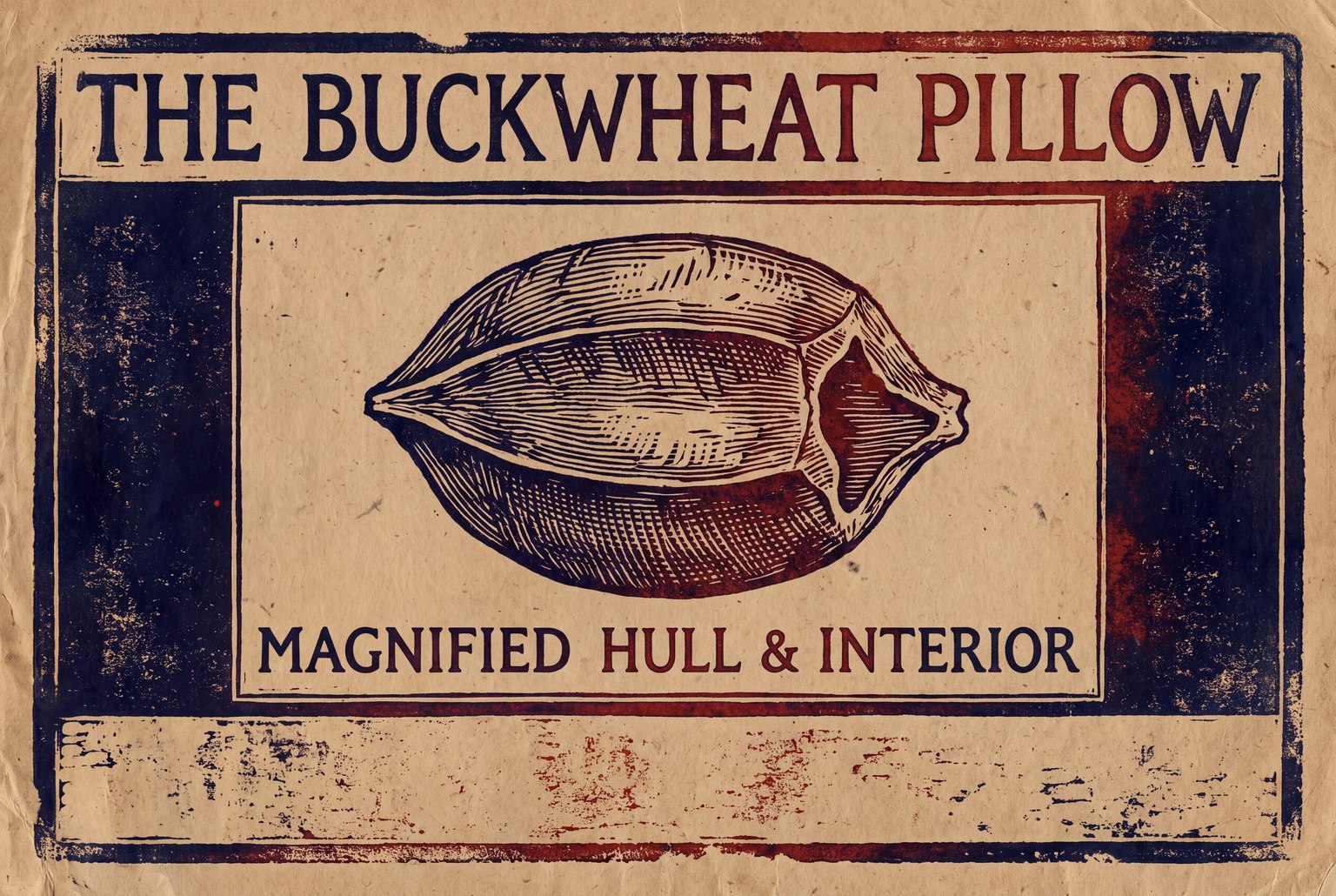
A buckwheat pillow holds its shape because the hulls interlock rather than compress, and every other property of the pillow follows from that.
- ~10 cm
- pillow height published for side sleeping
- Healthcare review, 2021
- 66.4%
- change in cervical angle from a 110 mm to a 170 mm pillow
- Ren et al., PeerJ 2016
- 1 in 5
- sleepers who report never adapting to hull sound
- commonly reported; our own reading of the literature
Where to start
What is a buckwheat hull?
The hard outer casing of the buckwheat seed, roughly pyramidal, with three flat faces that catch against each other.
That geometry is the whole mechanism. Interlocking hulls form a structure that supports a head at whatever shape it was pushed into, and stays there until it is pushed again.
How loud is it, honestly?
Loud enough that roughly one sleeper in five never adapts, and that figure belongs near the top of any page about these pillows.
The sound is hulls sliding across each other under load. It falls as the fill settles and it never disappears. Anyone who tells you it goes away entirely has not slept on one.
What is covered here?
Hull anatomy and processing, the living-with-it questions, fit and support, upkeep, and the buckwheat-and-wool hybrid in full.
Anatomy, milling, what polishing changes, quality tiers, and where hulls are grown.
What reduces the sound, the first ten nights, and who never adapts.
Filled weight, loft, and spinal alignment by sleep position.
Moisture, the real mould risk, refill intervals and replacement.
Buckwheat and wool in one pillow, including the wool-side facts the comparison needs.
Latest guide
Can a buckwheat pillow get moldy or bring bugs into your bed?
Buckwheat hulls are the dry outer shells of buckwheat seeds, and like any stored plant matter, they can grow mold or host insects if they stay damp. Humidity is the number that decides it. Mold will begin to develop at a relative