What is a Japanese buckwheat pillow, and how is it different from a US one?
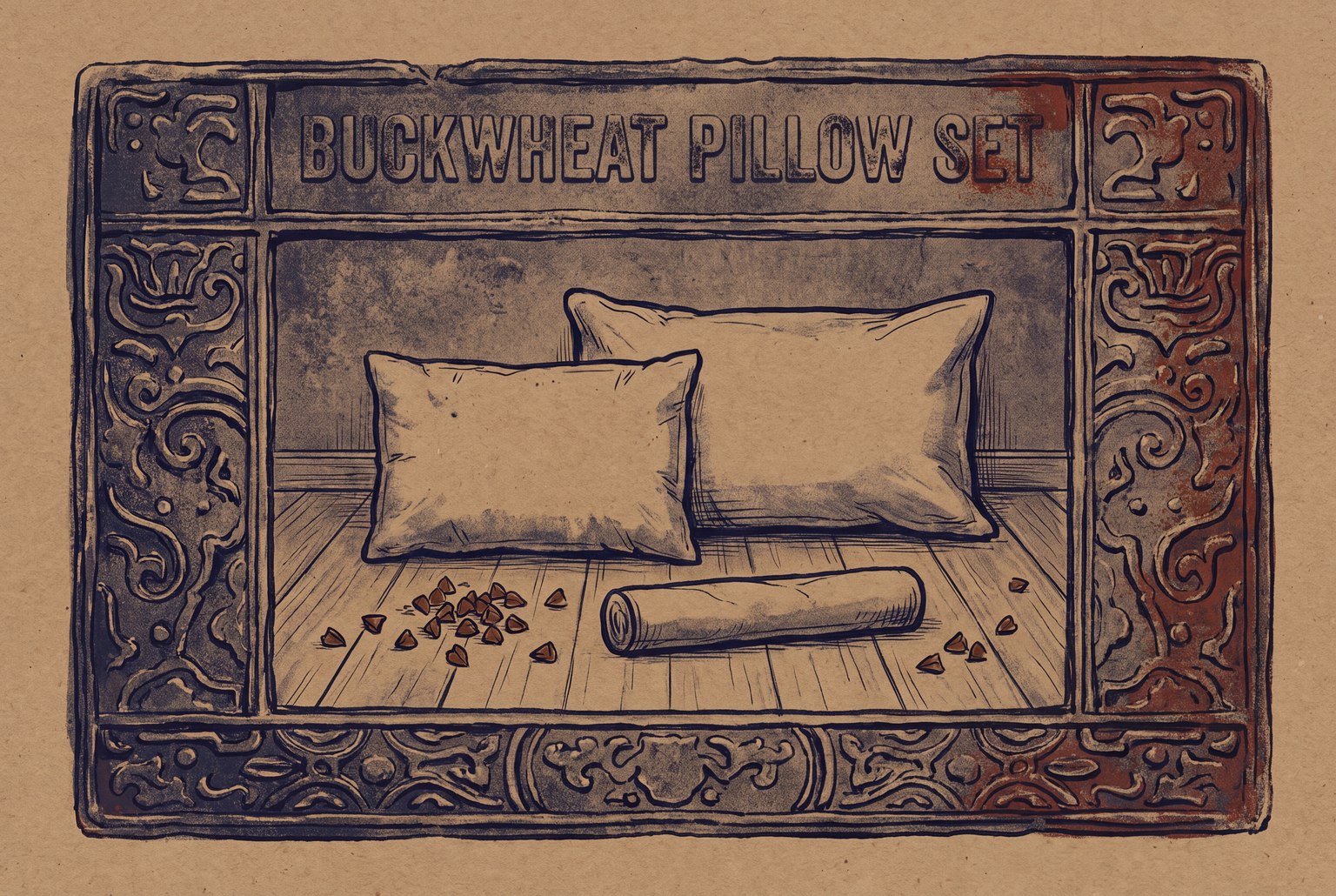
In Japan a buckwheat pillow is a soba gara makura. The traditional one is much smaller than an American bed pillow. One pillow made in Japan comes in a small size of 13.7″ x 19.6″ (35cm x 50cm) holding 3.3 lb (1.5 kg) of hulls (Futon Tokyo). A US standard pillow is 20 by 26 inches (PineTales). Most surprises come from that gap.
Short answer: A Japanese buckwheat pillow is a compact cotton case filled with buckwheat hulls, the dry shells left over once the seed is removed. In Japan it is called soba gara makura. Traditional sizes run about 13 to 17 inches wide and 18 to 25 inches long, which is smaller than the 20 by 26 inch US standard. You set the height by adding or taking out hulls. A Korean buckwheat pillow has the same fill but is more often sold as a narrow block or a neck roll.
This guide is for: people in the United States who want the traditional Japanese or Korean buckwheat pillow and need to know what size, weight and height they are getting.
Key Takeaways
Three facts matter most when you buy a Japanese or Korean buckwheat pillow in the US, and each one carries its own number.
- A traditional Japanese pillow is about half the area of a US one. A small pillow made in Japan measures 13.7 by 19.6 inches (35 x 50 cm) (Futon Tokyo). The US standard is 20 by 26 inches, so a standard pillowcase will not fit it well (PineTales).
- Weight tells you how full the pillow is. A US-made 13 by 18 inch rectangle weighs 3.8 lb (J-Life International). Another maker's 14 by 20 inch pillow weighs about 6.5 lb (PineTales).
- Four of the 6 seller pages we read were compact rectangles. The other 2 were neck rolls. Three of the 6 gave no fill weight at all.
On This Page
Each section below answers one question about the Japanese buckwheat pillow, from size and weight to allergy risk and care.
What makes a buckwheat pillow Japanese?
Tradition is what makes it Japanese. Japanese pillows are small, firm and filled to the top, and the style has been sold in Japan for centuries.
The Japanese name is soba gara makura. Soba means buckwheat, gara means hull and makura means pillow. One US seller of the style says use of soba gara makura (buckwheat hull pillows) dates back to the 15th century in Japan (J-Life International). That date comes from a seller, and no historian is cited for it. Research backs the wider point. A Korean pediatric study notes that buckwheat hull pillows are commonly used in Korea and Japan (Clinical and Experimental Pediatrics, 2016).
The Japanese pillow has three habits that set it apart from a US one. First, the pillow is small. Second, it is filled firmly. One listing for a pillow made in Japan says that since buckwheat hull pillows are filled to the brim, it is too tight to put them in a fastener-type cover (Futon Tokyo). Third, you adjust it through an opening in the case, taking hulls out until the height suits you.
The same listing says its Japanese grown buckwheat hulls are heated in a kiln at about 100 ºC (212ºF), and microwaves are used to kill insects and eggs. Clean hulls and a small case matter more than the country the hulls came from. Japanese households still use these pillows, and many pair them with shikifuton, the thin mattresses laid on the floor.
How big is a Japanese buckwheat pillow compared with a US standard pillow?
A traditional Japanese pillow is roughly 14 by 20 inches, while the US standard is 20 by 26, so the two need different pillowcases.
Two sizes let you match the pillow to your frame. The pillow made in Japan comes in small at 13.7 by 19.6 inches and large at 16.9 by 24.8 inches (Futon Tokyo). US makers round the numbers, to 13 by 18 inches at one (J-Life International) and 14 by 20 at another (Amazon listing).
| Pillow | Size (inches) | Fill weight the seller gives |
|---|---|---|
| Made in Japan, small (Futon Tokyo) | 13.7 x 19.6 (35 x 50 cm) | 3.3 lb of hulls (1.5 kg) |
| Made in Japan, large (Futon Tokyo) | 16.9 x 24.8 (43 x 63 cm) | 5.5 lb of hulls (2.5 kg) |
| US-made rectangle (J-Life International) | 13 x 18 | 3.8 lb |
| US-made "Japanese Size" (Amazon listing) | 14 x 20 | Not given on the page |
| US standard (PineTales) | 20 x 26 | about 12 to 13 lb |
The size gap has a cost. A standard US pillowcase will bunch up around a Japanese pillow, and a zippered case may not close over it. The Japanese seller pairs its small pillow with an envelope case of 33.4 by 13.7 inches (85 x 35 cm) (Futon Tokyo). The case wraps around and tucks in. If you buy a Japanese-size pillow, budget for a case made to fit it.
How much does a Japanese buckwheat pillow weigh?
Seller figures run from about 3.3 lb for a small Japan-made pillow to 6.5 lb for a fuller 14 by 20 inch one. Fill level sets the weight.
Buckwheat hulls are dense, so even a small pillow is heavy. The small pillow made in Japan holds 3.3 lb (1.5 kg) of hulls, and the large one holds 5.5 lb (2.5 kg) (Futon Tokyo). A US-made 13 by 18 inch rectangle weighs 3.8 lb (J-Life International). Another maker lists its 14 by 20 inch pillow at about 6.5 lb (PineTales).
Those two US pillows are close in size. One weighs far more than the other. The gap comes from how full each case is. PineTales sends its pillows out very full, 6–7 inches thick when fully filled, and expects you to take hulls out (PineTales). You do the trimming.
A listed weight tells you how full the pillow is. It says little about quality. A heavier pillow starts out taller. Once you adjust it, you have spare hulls to keep. It also takes more effort to push into shape in the middle of the night. That weight is what keeps the pillow where you put it, and our guide to buckwheat pillow weight explains why the heaviness is part of the design. If you sleep on a floor mattress the way many Japanese households do, the weight also helps the pillow stay put when you turn over.
Is a Korean buckwheat pillow different from a Japanese one?
The fill is the same buckwheat hull. Korean listings lean toward narrow blocks and neck rolls, often mixed with cypress wood chips.
In Korean the pillow is called memil begae (메밀베개). It holds the same hulls as a Japanese one. The shape is what changes. Some sellers also mix a second material into the fill, so read the listing closely.
Korean listings aimed at US buyers tend toward narrow shapes. One is a neck roll with the perfect size (12" x 4" x 4"), filled with buckwheat hulls and cypress chips (Kepitome). Another, sold by a US Korean bookseller, measures 18 by 4 by 4 inches (Hanbooks). Neither is meant as your only pillow. A roll that size fits under your neck, behind your lower back or under your knees.
If you want a full sleeping pillow, look at the dimensions before the name. Some Korean items are neck rolls. They support your neck while your head rests on another pillow. One Amazon listing says it outright: it is intentionally smaller than a standard sleeping pillow (Amazon listing). Cypress chips change how the pillow feels. If you want hulls alone, check the fill list before you order.
What did the seller pages we read say about size and fill?
We read 6 seller pages for Japanese and Korean styles. Four were compact rectangles, 2 were neck rolls, and 3 gave no fill weight.
We read 6 seller product pages on September 26, 2026. Each was for a pillow sold under a Japanese or Korean name. We counted what each page said about shape and fill weight. The count uses page text only, and we held no pillow. The six pages are linked in the table.
By shape, in three buckets:
- Compact rectangle made in Japan: 1 of 6
- Compact rectangle made in the US, 13 to 14 inches wide: 3 of 6
- Neck roll, about 4 inches across: 2 of 6
By fill weight, in three buckets: 1 page gave the weight in both pounds and kilograms, 2 gave pounds only, and 3 gave no weight.
| Page | Sold as | Shape bucket | Fill weight given |
|---|---|---|---|
| Futon Tokyo | Japanese | Rectangle made in Japan | 3.3 lb (1.5 kg) |
| J-Life International | Japanese | Rectangle made in the US | 3.8 lb |
| PineTales | Japanese | Rectangle made in the US | about 6.5 lb |
| Amazon listing | Japanese | Rectangle made in the US | None |
| Kepitome | Korean | Neck roll | None |
| Hanbooks | Korean | Neck roll | None |
The pattern in the count is simple. Both neck-roll pages left out the fill weight. Among the rectangles, only one page left it out too. Weight is your best clue to how full a pillow will arrive. If a listing gives none, ask the seller before you buy.
How high should a Japanese buckwheat pillow be for you?
No listed height is exact, because hulls compress under your head. Start full, then remove hulls until your neck sits level with your spine.
Treat the listed height of a buckwheat pillow as a starting point. Hulls shift and pack down under the weight of your head. One US seller says its pillows are approximately 6'' high when full (Sweet Zzz). The same page tells buyers they can remove hulls to make the pillow suit them.
The goal is a neck that stays in line with your spine. Back sleepers usually end up lower than side sleepers, because side sleepers have to fill the gap between ear and shoulder. Lie down in your usual position with the pillow as it arrived. Take out one cup of hulls at a time. Stop when your head is neither tipped forward nor dropped back. Save the spare hulls in a bag. Our height guide by sleep position goes through this step by step.
The table below is this publication's own judgement, based on the sizes above. No maker publishes it.
| Style | Suits | Watch for | Our judgement |
|---|---|---|---|
| Compact rectangle | Back sleepers, floor mattresses | Small surface to turn on | Closest to the tradition; try this first |
| Narrow block | Back sleepers who like a firm ridge | Little room to turn your head | Better as a second pillow |
| Neck roll | Neck support, reading, travel | Not a full pillow | Buy it as an addition, not a replacement |
| 20 x 26 in | Side sleepers with broad shoulders | 12 to 13 lb in one seller's figure | The US adaptation, and far less Japanese |
Can a buckwheat pillow cause allergy or asthma?
Rarely, but it is documented. Case reports link buckwheat pillows to asthma and anaphylaxis in people who become allergic to buckwheat.
Buckwheat hulls hold little protein. An allergist quoted by HealthDay said buckwheat flour left over from processing can cause problems. The hull itself, the allergist said, is unlikely to (HealthDay, 2001). The published cases fit that explanation.
Reactions still happen in some people. An allergen guide from Thermo Fisher Scientific says several people using buckwheat hull pillows in Germany and the US reported allergic symptoms (Thermo Fisher Scientific). The same guide says multiple cases of anaphylaxis have been tied to sensitization from buckwheat pillows. A 2021 review of buckwheat allergy research counted 9 articles that mention buckwheat pillow allergy (Norbäck and Wieslander, Plants, 2021).
Buckwheat allergy itself is uncommon. The same review estimates that the prevalence of buckwheat allergy in the population can be estimated as 0.1–0.4% in Japan, Korea and the parts of China where buckwheat is eaten (Norbäck and Wieslander, Plants, 2021).
If you already react to eating buckwheat, do not sleep on a buckwheat pillow. Watch for a stuffy nose or wheeze. If it eases when you sleep elsewhere, tell your doctor about the pillow. Flour residue is the likely trigger. Ask the seller how the hulls were cleaned. One US maker says its hulls go through a triple cleaning process to remove dust, buckwheat flour and debris (Amazon listing).
How do you care for a Japanese buckwheat pillow in a US home?
Dry it in the sun now and then, never wash the hulls, and use an envelope case. Keep spare hulls to top up the pillow as it settles.
Japanese care routines work in most US homes. A US seller says the pillow should be sunned outdoors occasionally to avoid moisture retention (J-Life International). Air it more often in humid weather. Wash only the case, and never the hulls (PineTales).
Hulls settle and pack down over time. One seller advises you to keep any hulls you remove, because the seeds in your pillow might settle and compress slightly over time (J-Life International). Top up the pillow when it starts to feel flat. A cup at a time is enough.
Estimates of how long the hulls last vary widely. A Japanese retail guide gives buckwheat 1–2 years (MADE in JAPAN.JP). A US maker says its filling lasts 5–10 years (PineTales). The most useful test is the one the Japanese guide gives: powder in the case and hulls you can feel through the fabric. A flat, dusty pillow is due for new hulls. Our guide to buckwheat hulls and moisture covers storing the pillow in damp rooms.
Common questions
Here are short answers to the questions people ask most about Japanese and Korean buckwheat pillows bought in the United States.
What is a Japanese buckwheat pillow called in Japan?
In Japan the pillow is called soba gara makura, which means buckwheat hull pillow. In Korean the same pillow is memil begae. The fill is the same in both countries. The shapes on sale differ more than the names do.
Will a US pillowcase fit a Japanese buckwheat pillow?
It will not fit well. A standard case is cut for a 20 by 26 inch pillow, and the traditional Japanese one is about 14 by 20. Zippered cases can also be too tight over a firmly filled pillow. An envelope case made for the size works best.
Does a Japanese buckwheat pillow fit a zippered cover?
Often the cover will not fit. One Japanese seller says its pillows are filled so full that a fastener-type cover is too tight. The seller pairs them with an envelope case instead. You adjust the height through an opening in the inner case.
Are Japanese-grown hulls better than US-grown hulls?
The pages we read did not show that. Pillows made in Japan use hulls grown in Japan. Two US makers use hulls grown in the US. Cleaning and heat treatment matter more to you than where the hulls were grown, because flour residue is what causes allergy problems.
Can you use a Japanese buckwheat pillow on a regular mattress?
Yes, you can use one there. The pillow was designed for a floor mattress, but it works on any bed. On a soft mattress your shoulder sinks further, so side sleepers may need to keep more hulls in. Adjust the height after a few nights, once you know how you settle.
Is a Korean buckwheat neck roll a full pillow?
Usually a roll is not. Rolls about 12 inches long and 4 inches across are made to support your neck alongside another pillow. They also work under your knees or lower back. If you want a single pillow to sleep on, choose a rectangle.