Plainly
Yes, but slowly. Two published analyses put a common buckwheat hull at about 31.6% lignin and 35.6% cellulose (IJMS, 2019), so a compost pile breaks hulls down the way it breaks down straw, not food scraps. Count them as browns and add one part fresh greens for every two or three parts browns. Keep them damp, and screen out whole hulls so they go through again. Hulls that carried insects need more than 72 hours above 131°F (UF/IFAS).
This guide is for: people emptying a worn buckwheat pillow who want the hulls to end up in a compost pile or a garden bed, not a landfill.
Key Takeaways
Three things decide whether old pillow hulls belong in your compost: how tough they are, how you mix them, and where they end up.
- About a third of each hull is lignin (31.6% to 34.8% across two analyses), so hulls compost like straw, not like kitchen scraps.
- Mix 2 to 3 parts browns with 1 part greens by volume, count the hulls as browns, and keep the pile damp.
- Of 13 seller pages we read, only 3 mention composting. Most name mulch instead, and raw hulls dug into soil can take nitrogen away from plants.
Can buckwheat hulls go in a home compost pile?
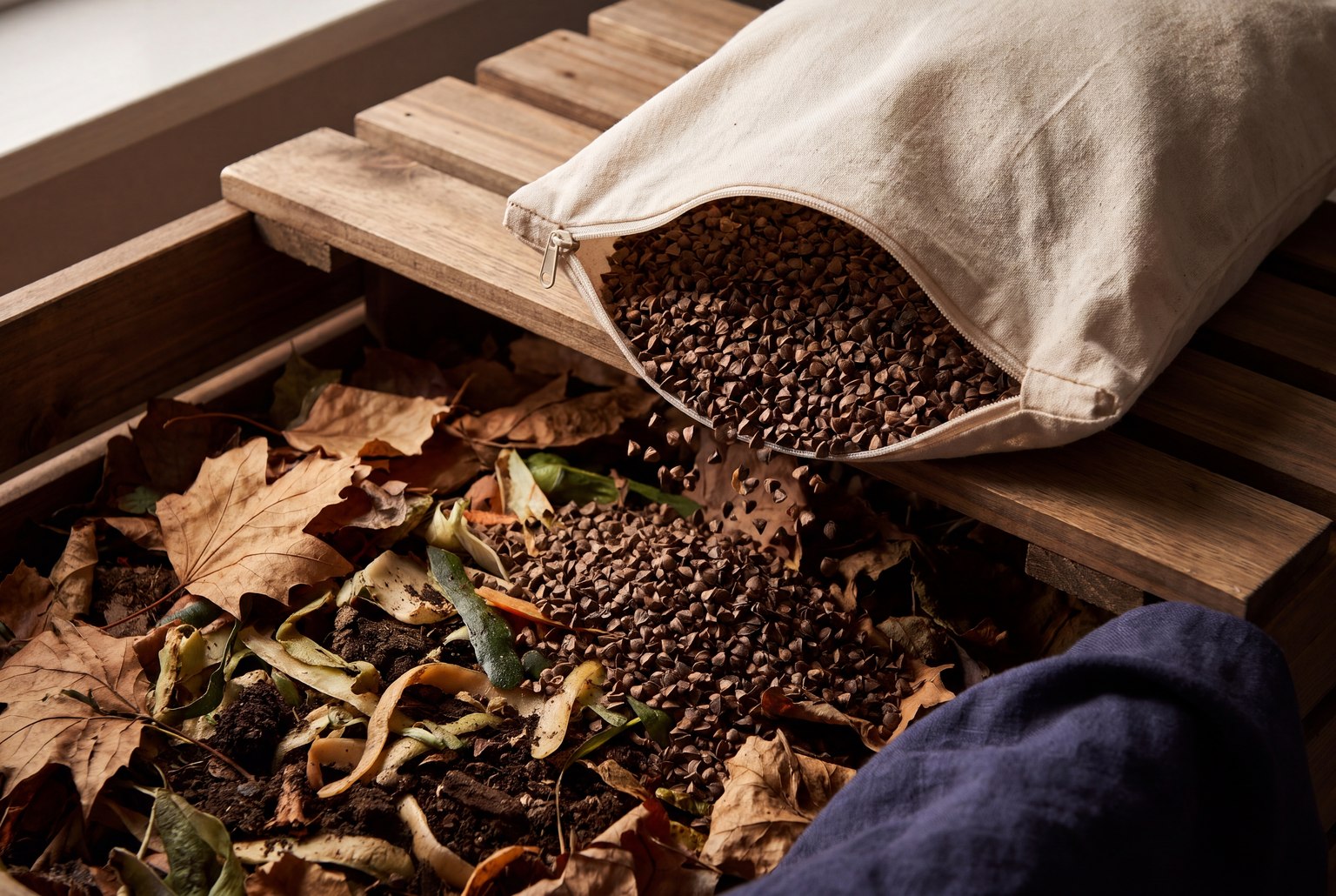
Yes. Spent hulls are a carbon-rich brown that a backyard pile will accept, but they arrive dry and tough, so they need greens and water with them.
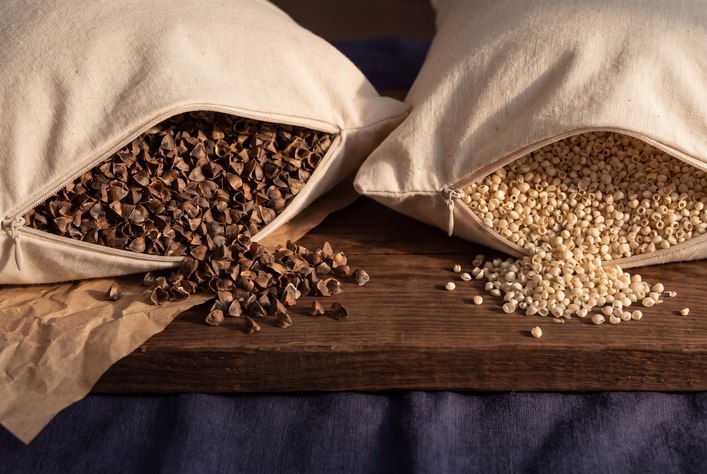
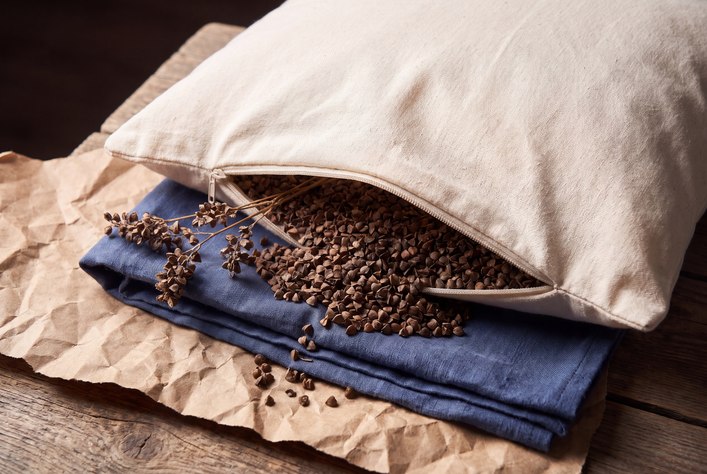
They go in as a brown. The EPA sorts backyard compost ingredients into carbon-rich browns and nitrogen-rich greens (EPA), and dry plant shells belong on the brown side. A hull is exactly that. It is the hard outer shell that comes off the buckwheat seed at the mill. Our page on how a buckwheat hull pillow works explains what the shell is and why its shape matters.
A hull is almost all plant fiber, and that is why it composts. A 2023 study describes buckwheat hulls as a largely unexplored source of dietary fiber (IJMS, 2023). Microbes can digest that fiber, just slowly.
One home composting guide lists buckwheat hulls among its browns and credits them with excellent aeration (Home Compost Guide). That fits the shape. Each hull holds a small pocket of air, and a working pile needs air to keep rotting the way it should.
So you can tip a pillow's worth of hulls into a bin that is already running. They will not harm the pile, but they will not feed it quickly either. The sections below explain how to get them to break down within a season or two, so they don't sit in the heap like gravel.
Why do buckwheat hulls break down so slowly?
About a third of a hull is lignin, the woody compound microbes digest last, and the rest is mostly cellulose locked inside it.
Lignin is the reason. It is the stiff compound that makes wood woody, and compost microbes break it down last. One analysis put common buckwheat hull at 31.6% lignin and 35.6% cellulose, and another at 34.8% and 36.5% (IJMS, 2019). Those two figures together leave little in a hull that microbes can eat quickly.
Composters rate browns by their carbon-to-nitrogen ratio. LSU AgCenter puts the best blend at about 25 or 30 to 1, with straw at 80:1 to 99:1 and sawdust as high as 500:1 (LSU AgCenter). We found no published ratio for buckwheat hulls. That gap matters. The table places hulls by what is known about their fiber, because no source we read prints a ratio for them.
| Material | Carbon to nitrogen | Source |
|---|---|---|
| Ideal starting pile | 25:1 to 30:1 | LSU AgCenter |
| Straw | 80:1 to 99:1 | LSU AgCenter |
| Sawdust | 500:1 | LSU AgCenter |
| Buckwheat hulls | Not published in any source we read; 31.6% to 34.8% lignin | IJMS, 2019 |
For your pile, the reading is simple. Hulls behave more like straw or sawdust than like kitchen scraps. They need extra nitrogen and extra time, and in return they keep the pile loose.
How should you mix old pillow hulls into a compost pile?
Treat the hulls as browns: wet them, spread them in thin layers, and pair every two or three scoops with one scoop of fresh kitchen scraps.
Start with the ratio. The EPA says to add at least two to three times the volume of browns to the volume of greens (EPA). Your hulls count toward the browns, so the greens have to come from your kitchen or your lawn.
The volume adds up quickly. A 6 to 7 lb pillow load is a lot of carbon to drop on a small bin at once. Feeding it in over several weeks keeps the mix in balance, and you can store the rest in a bucket with a lid until then.
Wet the hulls first. In our judgment, hulls that go in without soaking can sit inside a damp heap for weeks before water works its way into them. Soaking them in a bucket for an hour and draining them before they go in is worth the small effort, because microbes only work where there is moisture.
Then layer. The EPA suggests breaking tough materials into smaller pieces and layering greens and browns like lasagna. A thin sprinkle of hulls over each load of kitchen scraps works well. Keep every layer of hulls thin. A thick layer acts like a thick layer of sawdust, which compacts and slows the whole pile down.
How long until the hulls disappear in the pile?
No study we found has timed buckwheat hulls in a home pile, so plan on whole hulls still showing after one season and screen them back in.
None of the studies we read has timed buckwheat hulls in a home pile, and the sellers who recommend composting give no timeline either. Any month count you see online is a guess.
The evidence that does exist points one way. Virginia Cooperative Extension rates hulls as a mulch with a slow to medium decomposition rate (Virginia Tech, SPES-661). One pillow seller tells you to add spent hulls to compost or put them straight into soil (Kuseno). Mulch and pillows are both dry settings. A damp pile that gets turned is much harder on the hulls.
Here is our reading of that evidence, and it is judgment, not data. In a hot pile that gets turned, expect hulls to soften and darken within a season but stay easy to recognize. In a cold heap you rarely turn, many may look almost new after a year. Either way, you will probably see some.
Screening solves the problem. Sift finished compost through half-inch mesh, then put the hulls caught on top into the next batch as browns. The compost that falls through is ready to use. Nothing goes to waste, and each pass breaks the leftover hulls down further.
Can you spread old hulls straight on the garden instead?
Yes, as a thin mulch on top of the soil in a sheltered bed. Keep them on the surface, because dug-in raw hulls can borrow nitrogen from plants.
Yes, and it is the use most sellers name. The University of Connecticut lists buckwheat hulls as good for small plants, flowers and vegetable gardens, but warns they will blow away in windy, exposed areas (UConn). Virginia Cooperative Extension includes buckwheat among hulls that blow or wash away easily.
Keep the layer thin. Fedco, which sells hulls as mulch, suggests a layer ½ to 1 inch thick (Fedco Seeds). This Old House caps it at 1½ inches and suggests sprinkling the hulls with water regularly so they stay put (This Old House).
Do not dig raw hulls into the soil. UConn advises adding nitrogen before wood-derived mulches, because the microbes that break them down compete for limited soil nitrogen. Hulls are similarly woody. On the surface that competition stays thin. Mixed into a bed, it happens right where the roots are.
| Route | Effort | Main risk | Our judgment |
|---|---|---|---|
| Hot compost pile | High: turning, greens, water | Stalls if hulls go in thick | Fastest route if you already run one |
| Cold compost heap | Low | Whole hulls in the finished compost | Fine; screen and return them |
| Surface mulch | Low | Wind and rain move them | Good for sheltered beds and pots |
| Dug into soil raw | Medium | Nitrogen pulled from roots | Avoid |
| Trash | None | The material is lost | Last resort |
Is it safe to compost hulls that got moldy or buggy?
Moldy hulls are fine in a pile. Hulls that carried insects need a hot center, held above 131°F for three days, or a sealed bag in the trash.
Mold alone is no reason to keep hulls out, since fungi are among the organisms that break a pile down. The risk is to you, not the pile. Emptying a moldy pillow throws spores and dust into the air. One hull seller recommends a dust mask whenever you handle buckwheat hulls, because the dust may cause irritation (Organic Cotton Plus on Amazon). Pour them out of doors.
Insects are a different case. Our guide to whether a buckwheat pillow can get moldy or bring bugs into your bed explains how pillows pick them up. No source we read gives a kill temperature for insects in hulls. The nearest guide is what heat does to seeds and plant disease. UF/IFAS Extension says most seeds die after 72 hours above 131°F, and most plant diseases after 72 hours at 130 to 140°F.
The same page warns that a home pile is hard to mix well enough for all the material to reach the hot core. eOrganic adds that the edges and surface of a pile may not get hot enough (eOrganic). A cold heap is not a treatment. If your hulls carried live insects, bury them deep in a pile that is already steaming, or seal them in a bag for the trash. If you cannot tell whether a pile is hot, assume it is not.
What do you do with the pillow cover and zipper?
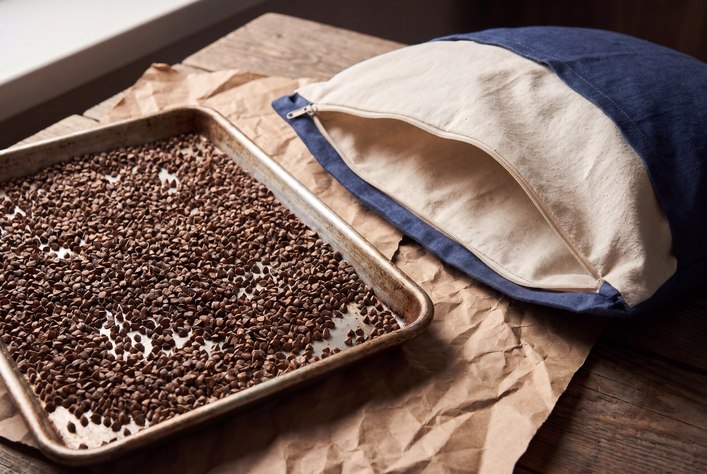
A cover that is 100% cotton can be cut up and composted once the zipper and any polyester thread come off. Blended fabric stays out of the pile.
Read the fabric content first, because plant fibers compost and synthetics do not. A composting reference site lists cotton among fibers that will compost down, and says polyester sewing thread, nylon and elastic won't break down (Compost This). It also advises tearing fabric into smaller pieces so it rots faster.
Covers differ even within one maker. Beans72 lists its plain standard pillow cover as 100% unbleached cotton (Beans72 on Amazon). Its quilted cover pairs a cotton surface with a polyester liner and polyester batting (Beans72 on Amazon). The plain cover can go in the pile in strips. The quilted cover cannot.
Cut out the zipper first. One composting writer says to remove buttons, zippers and snaps from natural-fiber clothing before it goes in the bin (Earth911). Another guide counts fabric scraps as browns (Can I Compost It). Brands often sew 100% cotton garments with polyester thread (Sustainable Jungle), and a pillow case can be made the same way. You will find those threads in the finished compost and can pick them out then.
A cover with any synthetic on its label stays out of the pile. If your town runs a textile recycling program, that is a better home for it.
What do pillow sellers say about composting spent hulls?
Of 13 seller pages we read, 3 told you to compost spent hulls, 6 named only a garden or mulch use, and 4 said nothing about old hulls at all.
We read 13 seller pages for buckwheat hulls or hull pillows on November 3, 2026, and counted what each one says about hulls that are done. This is a count of published text, not a test of anything.
| What the page says about spent hulls | Pages | Which pages |
|---|---|---|
| Tells you to compost them | 3 | Kuseno FAQ, Perfect Pillow FAQ, Herbco |
| Names a garden or mulch use, but not composting | 6 | PineTales refill bag, Organic Cotton Plus, an eBay 1 lb listing, an Etsy 5 lb listing, Adagio Acres, Fedco |
| Says nothing about what to do with them | 4 | Hullo pillow page, Beans72 standard pillow on Amazon, beans72.com pillow page, Zen Chi refill at Walmart |
The three that name composting give no ratio, timeline or warning. Perfect Pillow says hulls can go in your composter, garden or flower beds (Perfect Pillow). In the mulch group, PineTales says its hulls can also be used as garden mulch (PineTales). Hullo's product page calls its hulls biodegradable (Hullo) but gives no instruction.
In the text we read, none of the 13 mentioned nitrogen, wetting the hulls, or screening. Those three steps decide whether a load of hulls breaks down in your pile.
Common questions
Short answers to the smaller questions that come up once the hulls are out of the case and sitting in a bucket by the back door.
Do buckwheat hulls count as greens or browns?
Browns. They are dry, carbon-rich plant shells, closer to straw than to food. Balance them with fresh greens such as vegetable scraps, coffee grounds or grass clippings.
Should you crush the hulls before composting them?
It helps, though you don't have to. The EPA suggests breaking tough materials into smaller pieces before they go in. Crushed hulls give microbes more surface. Whole hulls keep more air in the pile.
How many pounds of hulls come out of one pillow?
One seller puts a standard bed pillow at 6 to 7 lbs and a king at 9 lbs or more. Beans72 lists its queen aromatherapy pillow at 9 to 12 lbs (Beans72 on Amazon).
Will old hulls attract rodents to the compost?
Not on their own. One pillow seller says the hulls have no nutritive value (Kuseno). The EPA says a properly managed bin will not attract pests or rodents (EPA). Bury food scraps, and the hulls make a good cover layer.
Can old hulls go in a city yard-waste or compost cart?
Ask first. The EPA's archived home composting page tells readers to check with their local composting or recycling coordinator about what curbside or drop-off programs accept (EPA archive). Rules vary by city.
Do you need a mask to empty an old pillow?
It is sensible, since one seller recommends a dust mask for handling hulls. Work outside on a calm day. If the hulls are still springy, our guide on how you clean a buckwheat pillow, and whether the hulls can get wet covers keeping them in use instead.
Sources
Hull pillow references used above, with the heading under which each one is cited.
- Organic Cotton Plus on Amazon (amazon.com), under “Is it safe to compost hulls that got moldy or buggy?”.
- IJMS, 2019 (pmc.ncbi.nlm.nih.gov), under “Why do buckwheat hulls break down so slowly?”.
- UF/IFAS (sfyl.ifas.ufl.edu), under the lead.
- EPA (epa.gov), under “Can buckwheat hulls go in a home compost pile?”; “How should you mix old pillow hulls into a compost pile?”.
- IJMS, 2023 (ncbi.nlm.nih.gov), under “Can buckwheat hulls go in a home compost pile?”.
- Home Compost Guide (homecompostguide.com), under “Can buckwheat hulls go in a home compost pile?”.
- LSU AgCenter (lsuagcenter.com), under “Why do buckwheat hulls break down so slowly?”.
- Virginia Tech, SPES-661 (pubs.ext.vt.edu), under “How long until the hulls disappear in the pile?”.
- Kuseno (kuseno.com), under “How long until the hulls disappear in the pile?”; “Common questions”.
- UConn (homegarden.cahnr.uconn.edu), under “Can you spread old hulls straight on the garden instead?”.
- Fedco Seeds (fedcoseeds.com), under “Can you spread old hulls straight on the garden instead?”.
- This Old House (thisoldhouse.com), under “Can you spread old hulls straight on the garden instead?”.
- eOrganic (eorganic.org), under “Is it safe to compost hulls that got moldy or buggy?”.
- Compost This (compostthis.co.uk), under “What do you do with the pillow cover and zipper?”.
- Beans72 on Amazon (amazon.com), under “What do you do with the pillow cover and zipper?”.
- Beans72 on Amazon (amazon.com), under “What do you do with the pillow cover and zipper?”.
- Earth911 (earth911.com), under “What do you do with the pillow cover and zipper?”.
- Can I Compost It (canicompostit.com), under “What do you do with the pillow cover and zipper?”.
- Sustainable Jungle (sustainablejungle.com), under “What do you do with the pillow cover and zipper?”.
- Perfect Pillow (perfectpillow.com), under “What do pillow sellers say about composting spent hulls?”.
- PineTales (pinetales.com), under “What do pillow sellers say about composting spent hulls?”.
- Hullo (hullopillow.com), under “What do pillow sellers say about composting spent hulls?”.
- Beans72 on Amazon (amazon.com), under “Common questions”.
- EPA (www3.epa.gov), under “Common questions”.
- EPA archive (19january2021snapshot.epa.gov), under “Common questions”.