What pillow height does a buckwheat pillow need, by sleep position?
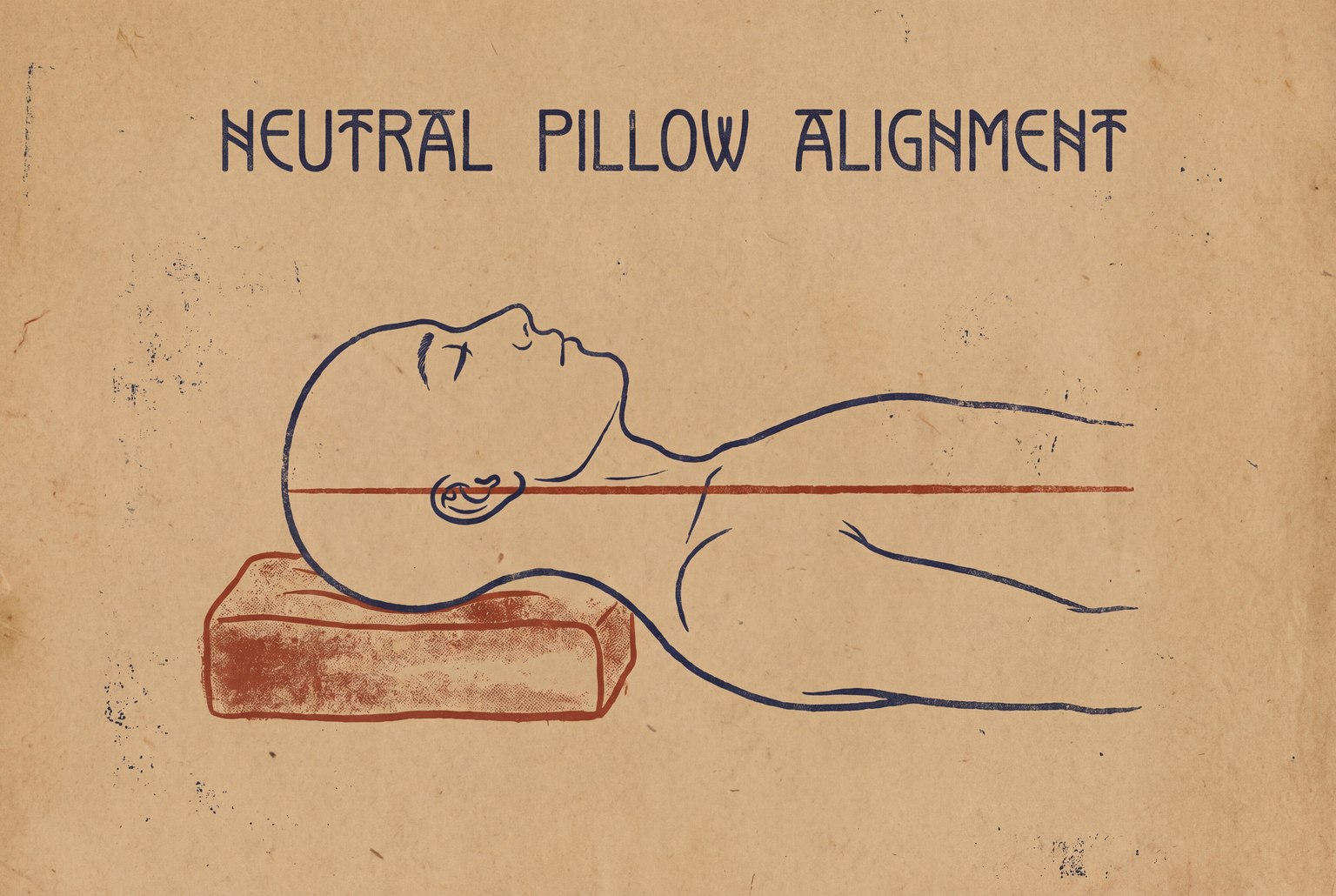
Published research converges on about 10 centimetres for side sleeping and 7 to 10 lying on your back. A buckwheat pillow is the one fill you can move between those two numbers yourself.
Short answer: Published measurements put side sleeping near 10 cm and back sleeping at 7 to 10 cm, so one sleeper needs two heights across a night. A buckwheat pillow is the fill that moves between them, because hulls interlock and hold the shape they are pushed into rather than springing back. Set the height from the gap between your ear and the point of your shoulder, then check that the neck lines up with the spine below it.
This guide is for: anyone who has read that a pillow should keep the neck neutral and wants to know what that means in centimetres.
We read the buckwheat pillow page of 16 sellers in September 2026, looking for one thing: whether the page tells you how tall the pillow will be. Three print a height figure in inches. Six print a fill weight and no height. Seven print neither, offering only the cover's length and width. Fourteen of the sixteen say hulls can be added or removed. So the adjustment the research asks for is nearly always possible, and the number you would adjust toward is nearly never on the page.
Key Takeaways
- Raising a pillow from 110 mm to 170 mm changed cervical angle by 66.4% and cut kyphosis distance by 43.4% in a 10-subject study.
- Published recommendations sit near 10 cm for side sleeping and 7 to 10 cm for supine, so one sleeper needs two different heights across a night.
- A 30-person crossover trial found a buckwheat pillow reduced shoulder pain where a latex pillow's change was not statistically significant.
On This Page
Why does pillow height change what the neck does?
A pillow sets the distance between the mattress and your head, and that distance decides the angle your cervical spine is held at all night.
Standing, the cervical spine carries a forward curve called lordosis. Lying down, a pillow either preserves that curve or forces the neck into flexion or extension. It holds it there as long as you stay put. What matters is how tall the pillow is under load, and what that height does to the seven vertebrae above your shoulders.
The load itself is small. A head weighs four to five kilograms, and nothing about lying down is strenuous. Duration is what makes the angle matter. The position is held for six or seven hours, and you do not correct it the way you would correct a slouch at a desk. You wake, shift and settle again. Nobody checks the angle of their own neck in the dark.
Two failures sit at either end of the range. Too low, and the head drops toward the mattress, closing the angle on the down side while the muscles on the up side are held long. Too high, and the neck is pushed into flexion, the chin drifts toward the chest, and the joints at the back of the neck carry the difference. Neither is dramatic in one night.
That is a measurable quantity, and it has been measured.
How much does height change the cervical spine?
A 2016 study measured pressure and spinal alignment across four pillow heights and found large, consistent shifts between the lowest and highest.
Ren and colleagues tested ten healthy adults on pillows of 110, 130, 150 and 170 millimetres, recording cervical angle, lordosis distance and kyphosis distance, alongside pressure at the head and neck (PeerJ, 2016). Six centimetres separated the lowest pillow from the highest. Across that span cervical angle rose 66.4 per cent and lordosis distance 25.1 per cent, while kyphosis distance fell 43.4 per cent and average cervical pressure rose about 65 per cent.
Two things follow. Six centimetres is not a small adjustment. And higher is not simply better, because the change that straightened the curve also raised the pressure the neck carries.
| Measure | Change from 110 mm to 170 mm |
|---|---|
| Cervical angle | +66.4% |
| Lordosis distance | +25.1% |
| Kyphosis distance | −43.4% |
| Average cervical pressure | ~+65% |
Ten subjects is a small sample. The authors measured healthy young adults rather than people with neck pain, so treat the direction as well established and the exact percentages as one study's numbers.
What height do side sleepers need?
Reviews land near 10 centimetres for lateral sleeping, because the pillow has to span the gap between the ear and the outside of the shoulder.
A 2021 review of pillow-height determinants gathered the position-specific recommendations and reported roughly 10 centimetres for the lateral position, with the supporting work measuring comfort and muscle activity rather than opinion (Healthcare, 2021). A 2024 study of side sleepers specifically put the best-performing individualised range at 9.74 to 11.76 centimetres (PubMed, 2024).
The reason it is a range is anatomical. The gap is the distance from your ear to your shoulder. Broad shoulders need a taller pillow to reach the same neutral neck.
The mattress moves that number as much as the shoulder does. A firm surface holds the shoulder up, so the gap stays close to its standing width. A softer one lets the shoulder sink, which narrows the gap and lowers the height the pillow has to deliver. Two people of the same build can need different pillows. You can need a different one yourself after changing a mattress. That is why a published figure is a starting point rather than a prescription, and why the studies report ranges instead of one value.
What changes when you roll onto your back?
Supine, the shoulder is no longer in the way. The gap collapses and the same neck needs a lower pillow, commonly 7 to 10 centimetres.
The review above reports 10 centimetres as most suitable for maintaining physiological curvature in supine, with other work finding 7 centimetres more comfortable. Read that spread plainly. Even within one position, the literature disagrees by three centimetres.
Position changes are not rare events. You move through a dozen or more postural changes in a night. Most people spend part of the night on a side and part of it on their back. A pillow with one fixed height is correct for part of the night by arithmetic alone.
The anatomy behind the smaller number is plain enough. Supine, the back of the skull rests on the pillow, and the gap to be filled is the hollow behind the neck rather than the span out to the shoulder. That hollow is shallow. Fill it and the curve is supported. Overfill it and the head is tipped forward, which is the same flexion problem a too-tall pillow creates on the side.
What the evidence agrees on is the direction. Supine wants less height than lateral, and a pillow set correctly for one is wrong for the other.
Where does that leave stomach sleepers?
Prone sleeping turns the head ninety degrees for hours. No pillow height fixes that, so aim for the lowest height you can tolerate.
This site is not going to tell anyone their sleeping position is wrong. The mechanism is simple. Prone sleeping holds the cervical spine in sustained rotation whatever is under the head. Adding height stacks extension on top of that rotation. A very low pillow, or none, is the least bad option here.
There is also less evidence to work from. The position-specific figures published for side and back sleeping have no equivalent for prone, because the studies behind them measured cervical angle with the face toward the ceiling or the wall. A rotated neck is a different measurement problem, and nobody has published a height for it.
What can be said is directional. Lower is better. A fill that flattens is easier to live with than one that holds a moulded shape. Some sleepers cut the rotation by rolling onto one hip with a pillow under the chest. That turns a prone position into a shallow side one. None of that is a prescription. It is the honest shape of a question the literature has not answered.
Why does a hull pillow suit this problem?
Because the numbers describe two heights for one sleeper, and hulls are the fill you can move between them without a second pillow.
Buckwheat hulls interlock rather than compress, for the reasons set out in what a buckwheat hull is. A hull pillow holds the shape it is pushed into. It does not spring back. So it can be built into a wedge, taller where the shoulder gap is and lower under the head. Fill can be added or removed through the zip to move the whole pillow up or down the scale.
| Sleep position | Published height guidance | What that implies for a hull pillow |
|---|---|---|
| Side | ~10 cm, individualised 9.74–11.76 cm | Most fill; build a taller ridge under the neck than under the head |
| Back | 7–10 cm | Remove fill, or push hulls to the sides and flatten the centre |
| Front | As low as tolerable | Least fill; a hull pillow can go nearly flat, which most fills cannot |
This table is our judgement, not a measurement. The left two columns are the published figures cited above. The right column is our reading of what they mean for a fill that holds its shape. No manufacturer's page states it.
What does the published evidence consist of?
Four studies carry every number on this page. Their sizes and designs differ enough that the difference is worth showing rather than summarising.
| Source | Design | n | What it measured |
|---|---|---|---|
| Ren et al., PeerJ 2016 | four pillow heights, within-subject | 10 | cervical angle, lordosis, pressure |
| Healthcare review, 2021 | review of position-specific heights | n/a | height by sleeping position |
| Side-sleeper study, 2024 | four heights, motion capture + model | 9 | cervical curve, internal force |
| Lee & Lee, Korean J Health Promot 2019 | crossover, one week per arm | 30 | VAS pain, Neck Disability Index |
The designs share a limitation worth stating. All four are short: a single session in three of them, one week per arm in the fourth. None followed anyone for a month, which is the period over which a pillow either suits a sleeper or does not. Three of the four measured healthy volunteers rather than people with neck pain, so they describe what a pillow does to an ordinary neck rather than what it does for a painful one.
The instruments differ too. Cervical angle from an image, internal force from a model and pain from a questionnaire are three different kinds of number, and they are not interchangeable. A quantity that moves a great deal in one may barely move in another.
Every figure quoted on this page comes from one of those four rows. None of it is our measurement, and none of it involved a pillow in our hands.
Has anyone tested buckwheat against another fill?
One crossover trial compared buckwheat against latex in thirty elderly patients, and buckwheat performed better on shoulder pain.
Lee and Lee ran a crossover design in a convalescent hospital. One week per pillow, a seven-day washout, neck and shoulder pain on a visual analogue scale alongside the Neck Disability Index (Korean Journal of Health Promotion, 2019). Both pillows reduced neck pain and disability scores. The difference was shoulder pain, where the buckwheat group improved and the latex group's change was not statistically significant.
A crossover design is why so small a trial is worth reading. Each participant used both pillows. Each is their own comparison, so build, mattress and starting pain are held constant. The seven-day washout sits between the arms to stop the first pillow's effect carrying into the second. That is a sound structure at a small size.
What it cannot do is separate the fill from the height. Both pillows were used as supplied, and neither one's height was reported, so the result compares two products rather than two materials at a matched height. No published trial we have found compares two heights of the same fill.
The honest limits: thirty participants, all elderly and all in one facility, one week per arm. That is a signal, not a settled result, and it is the only head-to-head trial on this fill we have found, and the rest of the fill-by-fill picture sits under compared.
How do you set your own height without a laboratory?
Measure the gap the pillow has to fill rather than guessing at a number, then adjust the fill until the gap is closed with the head level.
Lie on your side against a wall. Have somebody measure from the point of your shoulder to the side of your head. That is the height the pillow must deliver under load, not unloaded. A fill that compresses has to start taller. A hull pillow will not compress much, which makes the measurement more directly usable.
Do it on your own mattress. A gap measured against a wall while standing is wider than the same gap on a mattress that lets your shoulder sink. The wall version overshoots. Lie down, have the measurement taken there, and treat the result as the height the pillow must hold once your weight is on it.
Then check it. With the pillow under you, a straight edge along the cervical spine should line up with the thoracic spine below. No visible tilt either way.
Then give it a week. A neck held at one angle for years will call almost any change uncomfortable at first. One night is not enough to judge it. Move a handful of hulls at a time rather than a scoopful. The adjustment that works is usually smaller than the one people reach for first.
Common questions
Does a taller pillow always reduce neck pain?
No. The same study that straightened the cervical curve with height also recorded about a 65 per cent rise in average cervical pressure, so height trades one thing against another.
Is there one correct pillow height?
No. Published figures cluster near 10 cm for side sleeping and 7 to 10 cm supine, and the correct value within that depends on the distance from your ear to your shoulder.
Can one pillow serve both side and back sleeping?
Only an adjustable one. The evidence describes two different heights, so a fixed-height pillow is right for one position and wrong for the other.
Do buckwheat hulls compress during the night?
Very little. They interlock rather than squash, The height you set is close to the height you get, unlike fills that sag under load. Keeping it there is a question of upkeep.
Is the buckwheat versus latex result strong evidence?
It is one small trial. Thirty elderly participants in a single hospital over two weeks is a signal worth knowing and not a basis for a general claim.
Does any of this diagnose a neck problem?
No. Everything here is mechanism and published measurement. Persistent neck pain is a clinical question and this page is not a clinical source.