Plainly
Four things besides hull amount change the feel. The biggest is how tightly the case holds the hulls. In a 2010 lab study, a bag of ground coffee went from soft to rigid with under a 0.5% change in packing (Brown et al., 2010). Next comes the state of the hulls. Then come overnight settling and any layer between your head and the hulls. Each hull stays hard whatever you do.
This guide is for: people who have already taken hulls out of a buckwheat pillow and still find it too hard.
Key Takeaways
Three findings carry most of the answer. Two of them point to checks you can make on your own pillow tonight, using only your hands.
- Removing hulls lowers a pillow without softening the hulls. 2 of the 8 seller pages we read say so outright. 4 of the 8 say the opposite.
- Confinement sets most of the feel. In a 2010 lab study, a bag of grains went from soft to rigid with under a 0.5% change in packing (Brown et al., 2010).
- Broken hulls pack denser. Ground hulls came to about 24.5 lb per cubic foot (Google Patents, US8133357B2). Whole hulls are listed at 13 lb (AccuTech).
Why does a buckwheat pillow still feel firm after you remove hulls?
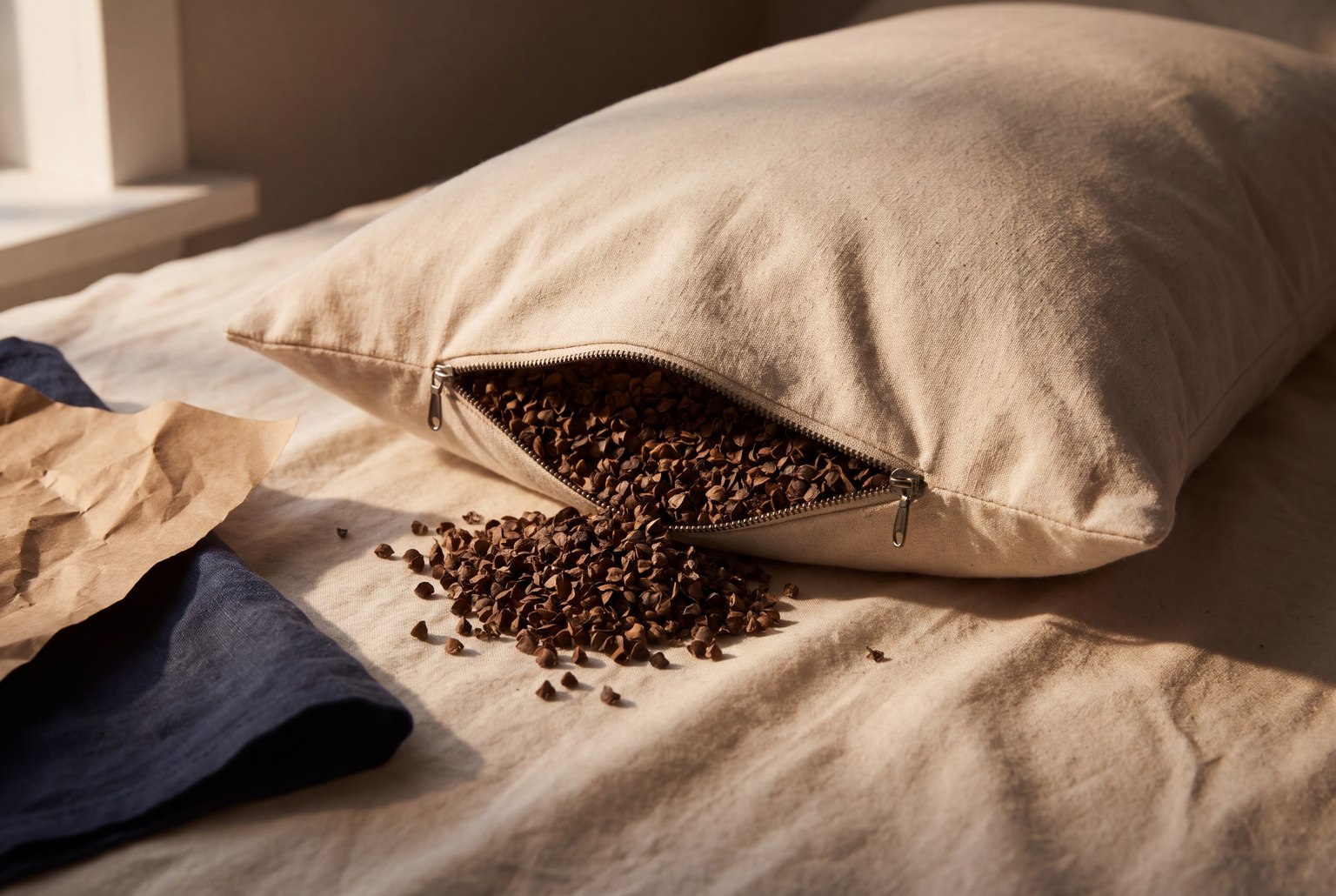
Removing hulls lowers the pillow and gives the fill room to move, but every hull stays as hard as it was before you opened the zip.
A buckwheat hull is a small, stiff shell. Taking some out does nothing to the ones left behind. What changes is the space around them. With more room, the hulls slide past each other and the pillow is easier to shape, so it can feel kinder under your ear. Press straight down on 1 spot, though, and you still meet hard shells.
One US seller says this plainly on its own product page. Taking hulls out, it writes, "does not make the pillow softer," only lower and easier to shape (PineTales). The Sleep Foundation's buying guide agrees. It names feeling too firm as the most common complaint about these pillows. It also says hulls let you adjust height but not firmness (Sleep Foundation).
So if you emptied a few cups and still wake up sore, you did nothing wrong. Hull amount mostly sets height. The firmness left over comes from 3 other places: how tightly the hulls are held, what shape the hulls are in, and what lies between your head and the fill. Each one takes a few minutes to check at home. The sections below take them in turn.
What do buckwheat pillow sellers say controls firmness?
Of eight seller pages read on 17 November 2026, four tie firmness to hull amount, two say it changes height only, two name a second layer.
We read 8 pages published by 5 sellers of buckwheat pillows on 17 November 2026. They were product pages, FAQ pages and the sellers' own guides. We sorted each page by what it says controls firmness. This is a count of published wording, with no weighing or testing, and each page sits in 1 bucket.
4 of the 8 say adding or removing hulls changes firmness.
2 of the 8 say removing hulls changes height and shaping, not firmness.
2 of the 8 name a second material as the softer part.
| Seller | Page read | What it says (paraphrased) | Bucket |
|---|---|---|---|
| Hullo | FAQ | Hulls set height and firmness | Amount |
| Turmerry | Guide | Fewer hulls, lower and softer | Amount |
| Turmerry | Product page | Remove hulls for a softer pillow | Amount |
| Mattress Miracle | Guide | Remove hulls for a softer pillow | Amount |
| PineTales | Signature pillow | Fewer hulls is not softer | Height only |
| PineTales | Neck roll | Lower with more give, not softer | Height only |
| PineTales | Platinum pillow | Padding gives the softer surface | Second material |
| FitMe | Filling instructions | More foam is softer | Second material |
PineTales lands in 2 buckets. Its pages differ. Half the pages tell people to empty hulls for a softer pillow. The rest say that will not work, or offer a second layer. Our reading of the physics, below, sides with them.
How does the pillow case change how firm a buckwheat pillow feels?
A taut case squeezes the hulls together so they lock and act like a solid, while a slack or stretchy case lets them flow away from your head.
Physicists call this jamming. In a 2010 study, a team filled a bag with ground coffee and pulled a vacuum on it. The grains switched between a soft, shapeable state and a rigid one with a change in packing density under 0.5% (Brown et al., 2010). A pillow case does a gentler version of the same job. It presses on the hulls from every side.
A case filled close to its seams keeps the hulls jammed. The surface then feels hard. A case with spare room, or one that stretches, lets the hulls move aside when your head lands. Hullo's sewing guide suggests a medium-weight cloth of 5 to 7 oz per yard for a standard bed pillow (Hullo). That cloth is sturdy, with little stretch. PineTales uses a jersey knit for the inner case of its neck roll (PineTales). A knit gives more under pressure.
A snug outer pillowcase adds to the squeeze. A zip-on protector that is a size too small for the pillow does the same thing. Take the outer case off for 1 night. If the pillow feels softer without it, the cover was part of your problem. A looser case will then help without touching the hulls.
Do broken or old hulls make a buckwheat pillow firmer?
Yes. Hulls crack into smaller, flatter bits over the years, and those pieces pack tighter, grip less and leave less give than whole hulls do.
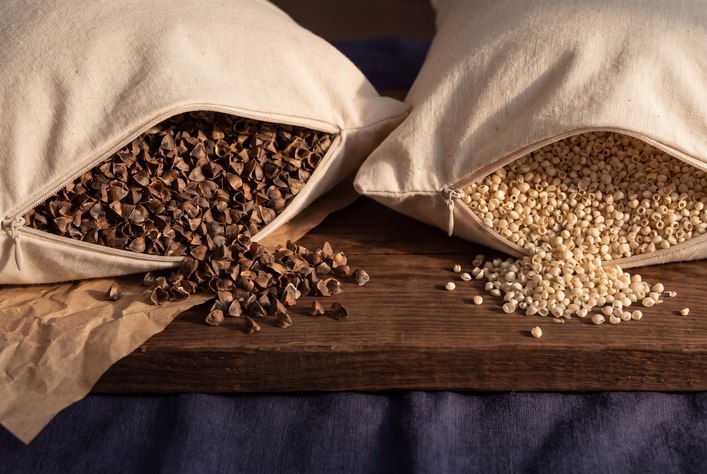
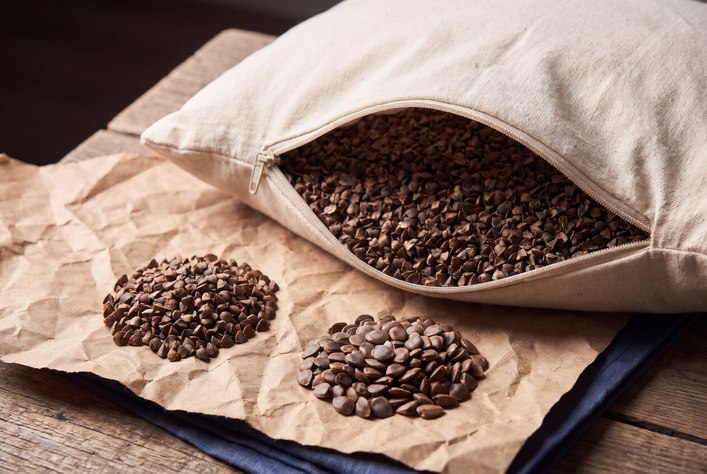
Whole hulls are hollow and three-sided, so a heap of them is mostly air. Break them and the air goes. A bulk-density reference lists whole hulls at 13 lb per cubic foot (208 kg/m³) (AccuTech). A US patent describes hulls ground in a mill until all of them passed a fine screen. The ground hulls came to about 24.5 lb per cubic foot (392 kg/m³) (Google Patents). That is nearly twice the weight in the same space.
| Hull form | Published figure | Source |
|---|---|---|
| Whole hulls, a seller's fill estimate | About 200 cubic inches per pound | Hullo |
| Whole hulls, bulk-density reference | 13 lb per cubic foot (208 kg/m³) | AccuTech |
| Whole hulls, second bulk-density chart | 13.0 lb per cubic foot | Paul O. Abbe |
| Hulls ground to pass a fine screen | 24.5 lb per cubic foot (392 kg/m³) | Google Patents |
Hullo's calculator page notes that hull volume depends on how tightly the hulls are packed (Hullo).
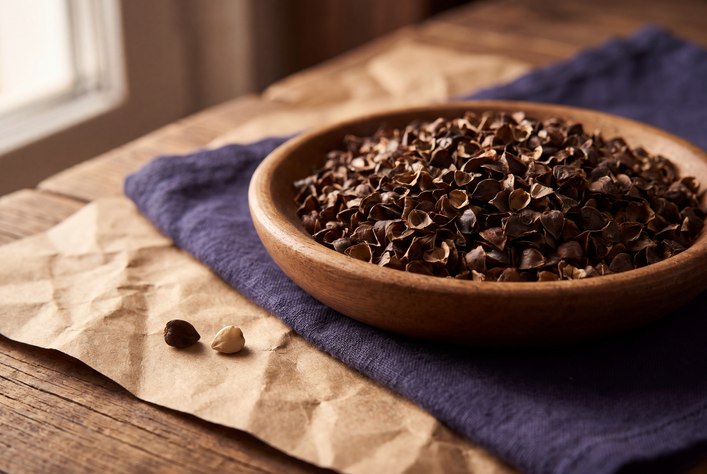
Pillow hulls never get ground that fine. They drift the same way, though. Hullo says hulls slowly break into smaller pieces, and that flattened hulls lose their rough edges, grip each other less and have less give (Hullo). Less give is what your neck reads as hard. An old pillow can feel lower and harder at once. That tempts people to add hulls when the worn fill is the trouble. Tip a handful into your palm. Cupped, whole shells are fine. A lot of flat flakes and brown grit means the fill wants replacing, not thinning.
Does hull polishing change how firm a buckwheat pillow feels?
It can. Polishing smooths the shell, so polished hulls slide past each other more easily, and makers disagree on whether that is a gain.
Rough edges catch on each other. That catch helps hold a shaped pillow in place. Hullo describes intact, rough-edged hulls as gripping one another better than worn, flattened ones (Hullo). It says a fill that has lost that grip holds its shape less well. Grip lets the hulls under your head lock into a firm shape. Without it, they slide out to the sides.
Smoother hulls slide more readily. A polished fill tends to flow out from under a pressing head rather than lock into place. Makers read that trade in opposite ways. PineTales keeps its hulls unpolished. Its product page argues that polishing hulls flat can weaken firm neck support and airflow (PineTales). Other makers treat a smoother fill as the point of polishing.
The effect cuts both ways. Smoother hulls give a more fluid feel under the head. If polishing flattens them, though, the flatter pieces pack denser, as the last section showed. Which effect wins depends on how far a batch was polished. The guide on what polishing changes in a buckwheat hull covers the process step itself. Here the point is practical. Two pillows holding the same weight of hulls can feel different because their hulls were finished differently. Fill weight alone will not tell you which one feels softer.
Why does a buckwheat pillow get firmer the longer you lie on it?
Your head's weight and each turn in the night press the hulls into a tighter pack, and a tighter pack feels harder until you loosen it.
Loose grains take up more room than shaken ones. Bulk-handling references report powders and granules 2 ways, freely settled and tapped, because vibration drives out air and packs them tighter (AccuTech). Another chart notes that bulk density shifts with particle size, moisture and handling (Paul O. Abbe). A night of small movements works like slow tapping.
Hullo says nightly compression packs the fill and costs it some volume over time (Hullo). Sweet Zzz tells people to fluff the pillow every day so the hulls do not compress (Sweet Zzz).
The coffee study shows why that matters. A change in packing under 0.5% can flip grains from soft to rigid (Brown et al., 2010). A pillow that felt right at bedtime can feel like a board by morning.
The fix costs nothing. Before bed, hold the pillow by 1 end and shake it. Then knead the middle with both hands so the hulls loosen. If you wake with a hard spot under your ear, a few seconds of the same will undo most of it. Damp air may play a small part too. A 2021 study found hull fillings passed air better than a polyester sponge filling and dried fast after wetting (IJERPH, 2021). Keep the pillow where air reaches it during the day.
Does how you shape a buckwheat pillow change how firm it feels?
Yes. Hulls piled into a ridge under the neck feel harder than the same hulls spread flat, because the ridge holds them in a deeper, tighter heap.
Shaping moves hulls. Where they end up changes the feel. Hullo's fill calculator says the working thickness of a moldable pillow can be several inches thinner or thicker than its average, depending on shape. Most people, it says, like an average of 3 to 4 inches (Hullo). A ridge pushed up under the neck is a taller, more crowded heap. Crowded hulls have less room to move.
FitMe tells people to shake the fill to the sleeping edge and build a high ridge where they want support (FitMe). That works for support. A ridge squeezed up with both hands is also a tighter pack, though. PineTales gives similar advice in its own guide: move the hulls where you want more support, then lie down and let them settle (PineTales).
After hulls come out, the rest tend to slump toward 1 end or 1 side. An uneven fill feels hard in one place and empty in another. People often blame the hulls when the spread is the cause. Lay the pillow flat and push the hulls into an even layer. Then lie on it before you build any ridge. Add shape a little at a time. In our judgement, much of the hard feeling after a hull removal comes from how the remaining hulls were left. How many remain matters less.
What can make a buckwheat pillow feel softer without removing hulls?
A soft layer between your head and the hulls does the most: a padded cover, a wool layer, or a blend with foam, each trading some firmness away.
Every option here changes what sits on top of the hulls, not the hulls. A layer between your head and the fill spreads the press of each hard edge over a wider patch of skin.
PineTales sells a model whose padded cover gives the softer surface over a hull core (PineTales). FitMe mixes shredded foam into the hulls, about 1/3 foam by volume (FitMe). It says more foam gives a softer pillow. A wool layer over hulls is another route, and the page on hull with a wool layer describes that build.
Test the idea before buying anything. Fold a thick towel over the pillow and sleep on it for 1 night. If that helps, a padded cover or wool layer should help more evenly.
The table is our judgement from the sources above. No maker publishes a ranking like it.
| What changes | Which way it pushes the feel | How to check it at home | Our judgement of its size |
|---|---|---|---|
| Case fullness and tension | Tighter is harder | Remove the outer case for a night | Large |
| Broken or flat hulls | More fragments, harder and lower | Tip a handful into your palm | Large in old pillows |
| Overnight settling | Packs harder as the night goes on | Shake and knead, then compare | Medium |
| Shaping into a ridge | Taller ridge feels harder | Spread the fill flat and retry | Medium |
| Polishing | Smoother hulls slide more | Read the seller's page | Small to medium |
| Soft top layer | Softer surface, same hulls beneath | Sleep one night on a folded towel | Large at the surface |
Common questions
Short answers to the questions people ask next, once they know the hulls themselves will not soften no matter how many come out.
Is a buckwheat pillow supposed to feel hard?
Firm, yes; hard on one spot, no. The Sleep Foundation rates most buckwheat pillows firm to very firm (Sleep Foundation). A sharp, hard spot usually points to a packed or uneven fill. Shaking and spreading the hulls fixes that.
Will a buckwheat pillow soften as it breaks in?
The hulls do not soften with use. What changes over the first nights is how you shape the fill and how used to it you become. Over the years, hulls crack into flatter pieces. Hullo says those have less give, so an old fill tends to feel harder.
Does a tighter pillowcase make a buckwheat pillow firmer?
It can. A snug outer case or a small protector squeezes the hulls together, and squeezed hulls lock into a firmer mass. Try 1 night with no outer case to see how much yours adds.
Can you mix something into buckwheat hulls to soften them?
Some sellers do. FitMe blends shredded foam with hulls at about 1/3 foam by volume and says more foam softens the pillow (FitMe). If you try a blend of your own, keep the removed hulls bagged. Then you can go back.
Why is my buckwheat pillow hard in one spot?
The hulls have probably slumped or been pushed into a heap. Lay the pillow flat, spread the fill into an even layer, and shake it end to end. If the spot comes back every night, look inside for flattened hulls and grit.
When does a firm buckwheat pillow mean the hulls need replacing?
It is time when the pillow feels both lower and harder than it used to. A handful from inside will show flat flakes and fine brown grit. Hullo says hulls break into smaller pieces with use and should be replaced from time to time (Hullo). Fresh hulls bring back the give that broken ones lost.
Sources
Hull pillow references used above, with the heading under which each one is cited.
- Brown et al., 2010 (ar5iv.labs.arxiv.org), under “Key Takeaways”; “How does the pillow case change how firm a buckwheat pillow feels?”; “Why does a buckwheat pillow get firmer the longer you lie on it?”.
- Google Patents, US8133357B2 (patents.google.com), under “Key Takeaways”; “Do broken or old hulls make a buckwheat pillow firmer?”.
- AccuTech (accutech.co.za), under “Key Takeaways”; “Do broken or old hulls make a buckwheat pillow firmer?”; “Why does a buckwheat pillow get firmer the longer you lie on it?”.
- PineTales (pinetales.com), under “Why does a buckwheat pillow still feel firm after you remove hulls?”; “What do buckwheat pillow sellers say controls firmness?”.
- Sleep Foundation (sleepfoundation.org), under “Why does a buckwheat pillow still feel firm after you remove hulls?”; “Common questions”.
- FAQ (hullopillow.com), under “What do buckwheat pillow sellers say controls firmness?”.
- Guide (turmerry.com), under “What do buckwheat pillow sellers say controls firmness?”.
- Product page (turmerry.com), under “What do buckwheat pillow sellers say controls firmness?”.
- Guide (mattressmiracle.ca), under “What do buckwheat pillow sellers say controls firmness?”.
- Neck roll (pinetales.com), under “What do buckwheat pillow sellers say controls firmness?”; “How does the pillow case change how firm a buckwheat pillow feels?”.
- Platinum pillow (pinetales.com), under “What do buckwheat pillow sellers say controls firmness?”; “Does hull polishing change how firm a buckwheat pillow feels?”; “What can make a buckwheat pillow feel softer without removing hulls?”.
- Filling instructions (fitmepillow.com), under “What do buckwheat pillow sellers say controls firmness?”; “Does how you shape a buckwheat pillow change how firm it feels?”; “What can make a buckwheat pillow feel softer without removing hulls?”; “Common questions”.
- Hullo (hullopillow.com), under “How does the pillow case change how firm a buckwheat pillow feels?”.
- Hullo (hullopillow.com), under “Do broken or old hulls make a buckwheat pillow firmer?”; “Does how you shape a buckwheat pillow change how firm it feels?”.
- Paul O. Abbe (pauloabbe.com), under “Do broken or old hulls make a buckwheat pillow firmer?”; “Why does a buckwheat pillow get firmer the longer you lie on it?”.
- Hullo (hullopillow.com), under “Do broken or old hulls make a buckwheat pillow firmer?”; “Common questions”.
- Hullo (hullopillow.com), under “Does hull polishing change how firm a buckwheat pillow feels?”; “Why does a buckwheat pillow get firmer the longer you lie on it?”.
- Sweet Zzz (sweetzzzmattress.com), under “Why does a buckwheat pillow get firmer the longer you lie on it?”.
- IJERPH, 2021 (pmc.ncbi.nlm.nih.gov), under “Why does a buckwheat pillow get firmer the longer you lie on it?”.
- PineTales (pinetales.com), under “Does how you shape a buckwheat pillow change how firm it feels?”.
Page history
- : First written