What are the benefits of a buckwheat pillow, and which hold up?
Sellers say buckwheat pillows ease neck pain, keep you cooler and help with allergies. Very little research tests those claims. What exists is one crossover trial of 30 older adults, a handful of allergy case reports, and one Korean lab study of new pillows. This guide checks each claim against what those sources found.
Short answer: A buckwheat pillow gives you firm support at a height you set yourself, and it holds that shape all night. One trial of 30 older adults found less neck and shoulder pain than on latex (KoreaMed, 2019). The allergy claim runs the other way for some people. Buckwheat allergy affects an estimated 0.1 to 0.4% of people where buckwheat is eaten often (PMC, 2021), and new buckwheat pillows carried over 12 times the endotoxin of synthetic ones (JKMS, 2004).
This guide is for: people deciding whether a buckwheat pillow is worth trying, and anyone who wants to know which seller claims have research behind them.
Key Takeaways
- The neck pain evidence rests on 1 small trial. A 2019 Korean crossover study of 30 older adults found buckwheat did better than latex for neck and shoulder pain (Korean Journal of Health Promotion, 2019). A meta-analysis of 9 high-quality studies with 555 participants favored rubber pillows instead (PMC).
- "Hypoallergenic" is the weakest claim. Buckwheat allergy affects an estimated 0.1 to 0.4% of people in Japan, Korea and parts of China (Norbäck and Wieslander, 2021). In a Korean study, new buckwheat pillows held over 12 times the endotoxin of synthetic ones (JKMS, 2004).
- Fill weight varies from seller to seller. We read 7 seller pages on September 25, 2026. The fill they list for a 20 by 26 inch pillow ran from 7 to 10 pounds.
On This Page
What is a buckwheat pillow?
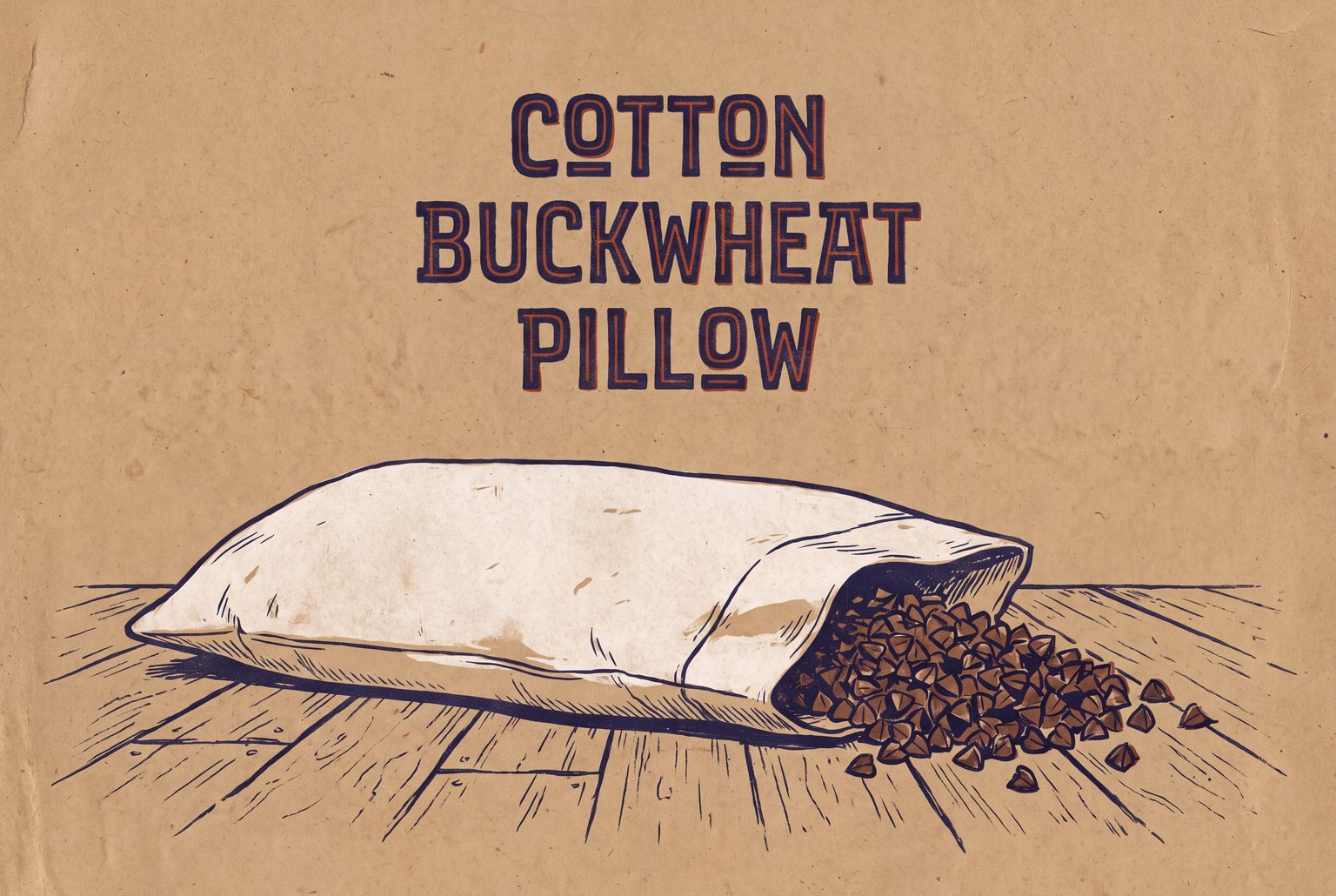
A buckwheat pillow is a zippered cloth case filled with the hard, three-sided shells left over when buckwheat seeds are hulled for food.
In Japan the pillow is called sobakawa (Hullo product page), and in Korea and Japan these pillows are in common use (Clinical and Experimental Pediatrics). The fill is a by-product of food processing. Hulls make up 30 to 40% of processed buckwheat, and most of that material is burned as fuel. Only a small share goes into pillows and mattresses. (PMC extraction study).
Each hull is a hard, angular shell. When you press the hulls together, they lock around the shape of your head and hold it. Down or fiber springs back instead. That is why most buckwheat pillows have a zipper: you set the height by adding or taking out hulls. In the United States the usual size is the standard 20 by 26 inch pillow. One refill seller says 10 pounds fills a standard pillow and 5 pounds fills the smaller 14 by 20 inch Japanese size (PineTales refill page). For you, that means the height you pick at bedtime is still there when you wake, and you can fine-tune it one handful at a time.
You will likely notice how it feels and how it sounds first. A full pillow is firm and heavy. It also rustles every time you turn over. Some people stop hearing it within days. Others never do, and this site has a separate guide on buckwheat pillow noise.
Which buckwheat pillow benefits have evidence behind them?
Adjustable height and firm support are real and easy to check. Pain relief has one small trial, and cooling and allergy claims have little.
Some benefits need no study. A pile of hulls either holds its shape under your head or it doesn't, and you can tell on the first night. The health claims are different because they depend on research, and there isn't much of it. The table below is our judgement after reading the sources linked in this guide. It is a reading of the sources, not a test.
| Claim sellers make | What the sources show | Our rating |
|---|---|---|
| Adjustable height | Hulls stay where you push them, and a zipper lets you remove fill | Holds up |
| Firm, even support | Hulls don't compress the way fiber does | Holds up |
| Less neck and shoulder pain | 1 crossover trial of 30 older adults (KoreaMed); a meta-analysis of pillow trials favored rubber pillows (PMC) | Weak |
| Cooler sleep | Airflow is plausible; we found no study that measured head temperature on buckwheat | Not shown |
| Hypoallergenic | Buckwheat is a food allergen, and case reports link these pillows to asthma (Thermo Fisher allergen encyclopedia) | Wrong for some people |
| Clean fill | In 1 study, new pillows held over 12 times the endotoxin of synthetic ones (JKMS) | Mixed |
The two claims that hold up are about how the pillow is built. The ones that fail are medical. If you want a firm pillow and control over its height, the evidence supports you. If you want relief from allergies, it points the other way. Nobody publishes a scorecard like this, because none of these ratings help sell pillows.
Does a buckwheat pillow help neck pain?
One trial of 30 older adults found less neck and shoulder pain on buckwheat than on latex. Reviews of pillow trials favor latex instead.
The trial people cite most is a Korean study from 2019. It was a crossover study of 30 elderly patients in a convalescent hospital, so each person used both a buckwheat pillow and a latex pillow (KoreaMed record). The authors concluded that the buckwheat pillow was the better of the two for reducing neck and shoulder pain (Korean Journal of Health Promotion, 2019). That result is narrow. The participants were older adults in care, and the trial periods were short. The abstract describes the schedule as 2 weeks per pillow in one place and one week in another.
Larger reviews point elsewhere. A meta-analysis of 9 high-quality studies with 555 participants favored rubber pillows for reducing neck pain (PMC abstract). A 2021 review found moderate evidence for latex as a pillow material (PMC). Buckwheat was not the winner in either.
Height may matter more than the fill. The same study on pillow height cites that 2021 review, which found moderate evidence for a height of 7 to 11 cm, a little under three inches to just over four (PMC). With a buckwheat pillow you can set a height in that range and it stays there, because the hulls don't sink during the night. Your sleep position decides where in the range you should be. The guide to pillow height by sleep position walks through it.
Does a buckwheat pillow keep your head cool?
Air moves through a pile of hulls in a way it cannot through foam, but no study we found measured head temperature on a buckwheat pillow.
Seller pages lean heavily on airflow. One says its hull fill lets air move freely through the pillow and stops heat from building up (Hullo product page). Another says the airflow will help keep your head cool on warm nights (ComfySleep listing). Airflow through hulls is plausible. A heap of rigid shells has gaps between them, and a block of foam doesn't.
None of the studies we found put a temperature sensor under someone's head on a buckwheat pillow. Reviews of pillow design do give some weight to cooling in general. The same review that supports a 7 to 11 cm height also lists a cooling surface as having moderate evidence (PMC). That supports cool pillows in general, not buckwheat in particular.
If you sleep hot, the case and pillowcase may matter as much as the fill. Hulls can only move air if your cover lets it through, so a thin cotton case that breathes makes sense. A thick synthetic protector may undo much of what the hulls offer. If you want to know whether it helps you, a few warm nights will tell you more than any seller page.
Is a buckwheat pillow hypoallergenic?
Not for everyone. Buckwheat is a known food allergen, and flour dust left on hulls has triggered asthma in people who sleep on these pillows.
Sellers use the word freely. One refill listing says its hulls are cleaned and heat-treated, making them ideal for people with sensitivities (Amazon listing). The medical record is less kind. A 2021 review puts buckwheat allergy at 0.1 to 0.4% of people in Japan, Korea and the parts of China where buckwheat is eaten. Among allergy clinic patients the figure is 2 to 7%. (Norbäck and Wieslander, 2021). The same review reports cross-reactivity with peanut, latex, coconut, quinoa and poppy seed.
Doctors have documented the link between pillows and allergy. In a 2001 Korean report, three children with asthma at night reacted to buckwheat flour and not to dust mites (Thermo Fisher allergen encyclopedia). Their symptoms improved within seven days of the pillows leaving their rooms, and testing traced the reaction to flour left on the hulls (HealthDay). A 2003 paper described a US patient who developed asthma and worse allergic rhinitis after using a buckwheat pillow (Thermo Fisher allergen encyclopedia).
Dust mites are a separate question. A Korean study found no mite allergen on new pillows. After 3 months, buckwheat and synthetic pillows held similar levels, 1.16 and 1.08 µg/g. (JKMS, 2004). So if dust mites set off your allergies, switching to buckwheat will not spare you the mite exposure you get on polyester.
Can a buckwheat pillow get moldy or dirty?
Hulls rarely grow mold unless moisture gets in. New buckwheat pillows in one study carried over 12 times the endotoxin of synthetics.
The Korean study that measured mite allergen also measured endotoxin, a substance shed by bacteria that can make asthma worse. New buckwheat pillows averaged 60,950 EU/g of endotoxin, compared with 4,887 EU/g on new synthetic pillows, a gap of more than 12 to 1 (JKMS, 2004). The buckwheat pillows had much higher levels at both time points. The authors called buckwheat pillows a source of very high endotoxin that may matter for people with allergic asthma. For someone without asthma, what this means in practice is unclear.
Mold comes down to moisture. A 2021 Polish study tested mattresses filled with buckwheat hulls, with 60 people taking part. It found fungi, bacteria and pests at a very low level. (IJERPH via PMC, 2021). It also notes that once grain moisture goes above 15%, mold can take over. The mold risk to you comes from where and how the pillow is kept, not from the hulls themselves.
Look after the hulls and let them air out. One seller tells owners not to wash the hulls and to refresh them in direct sunlight for a few hours (PineTales product page). Another says slightly wet hulls should dry out, and very wet ones can be spread on dry towels (Hullo product page). You can wash the case once you have emptied it. The guide to mold and bugs in buckwheat pillows covers storage and early signs of damp.
How heavy is a standard buckwheat pillow?
Sellers list 7 to 10 pounds of hulls for a 20 by 26 inch pillow, and the extra pounds give you a taller, firmer pillow that holds its shape.
The weight surprises people more than anything else. One seller says its standard pillow weighs 10 pounds, and that first-time buyers are surprised by how heavy and firm it is (Pure Living Space).
We read 7 seller pages for standard 20 by 26 inch buckwheat pillows or refill bags on September 25, 2026. For each one, we counted the fill weight the page states for that size. We weighed nothing ourselves, so these are the sellers' own figures.
| What the page states | Pages | Figures stated |
|---|---|---|
| 8 pounds | 2 | ComfySleep listing: 8 lb; ComfyComfy page: 8 lb plus 2 lb extra (same seller) |
| 10 pounds | 2 | Pure Living Space: 10 lb; PineTales refill: 10 lb |
| No single figure | 3 | Felizmax listing: 9.8 lb in one place, 7.5 lb in another; Hullo refill page: a 10 lb bag is more than enough; Hullo sewing guide: around 7 to 9 lb |
Across the 7 pages, the stated fill for one size ranged from 7 to 10 pounds. Two pillows sold as "standard" can differ by 3 pounds of hulls, and that changes both height and firmness. When you compare prices, compare pounds of fill as well as size. The guide to how much a buckwheat pillow weighs explains why the weight is what holds the shape.
Who should not use a buckwheat pillow?
Ask an allergist first if you react to buckwheat, latex or peanut. People who want a soft, quiet or light pillow may not like one at all.
The allergy evidence gives the clearest rule. If you have a buckwheat food allergy, or asthma that gets worse at night, talk to an allergist before you sleep on one. The same applies to a latex or peanut allergy, given the cross-reactivity reported in the 2021 review (Norbäck and Wieslander). Children with asthma at night belong here too. The 2001 report involved three of them.
Comfort rules out other people.
| If you | A buckwheat pillow is likely to | Why |
|---|---|---|
| Want a soft pillow you sink into | Disappoint | Hulls hold firm |
| Wake at small sounds | Bother you | Hulls rustle when you move |
| Lift or move your pillow often | Feel awkward | A standard one can weigh 10 lb |
| Sleep on your stomach | Need many hulls removed | Lying face down needs a low pillow |
| Sleep on your side or back and like firm support | Suit you | Height stays where you set it |
| Sleep hot | Maybe help, if the cover breathes | Airflow is plausible but not measured |
For many people, noise is what decides it. One seller says its pillow rustles when moved and most people adjust to the sound after a few nights (Hullo product page). Another admits that hull pillows tend to be noisy (Pure Living Space). Both can be true. If you are unsure, a small travel-size pillow is a cheaper way to find out.
Common questions
What is inside a buckwheat pillow?
Only the outer shells of buckwheat seeds, called hulls. The grain itself is removed and sold as food. Hulls are a by-product, and most of them are used as fuel. (PMC).
How long does a buckwheat pillow last?
No pillow study has measured this. The Polish mattress study reported high durability for the hull filling (PMC, 2021). Refill bags come in 5, 10 and 20 pound sizes (Hullo refill page), so you can top up the pillow instead of replacing it.
Can you wash a buckwheat pillow?
Wash the case, not the hulls. Empty the hulls into a bag, wash the case, and let it dry fully before you refill it. For the hulls, one seller suggests a few hours of direct sunlight (PineTales).
Is a buckwheat pillow good for neck pain?
It may help, but the evidence comes from 1 trial of 30 older adults (KoreaMed). A meta-analysis of pillow trials favored rubber pillows instead (PMC). Getting the height right probably matters more.
Do buckwheat pillows attract bugs?
Clean, dry hulls carry very little. The 2021 Polish study found pests at a very low level, linked to natural colonization during harvest and storage (PMC). Damp storage is what raises the risk.
Are buckwheat pillows safe for children?
For most children, yes. If your child has asthma or a food allergy, get medical advice first. In the 2001 Korean report, the night-time asthma of three children improved once their buckwheat pillows were removed (HealthDay).